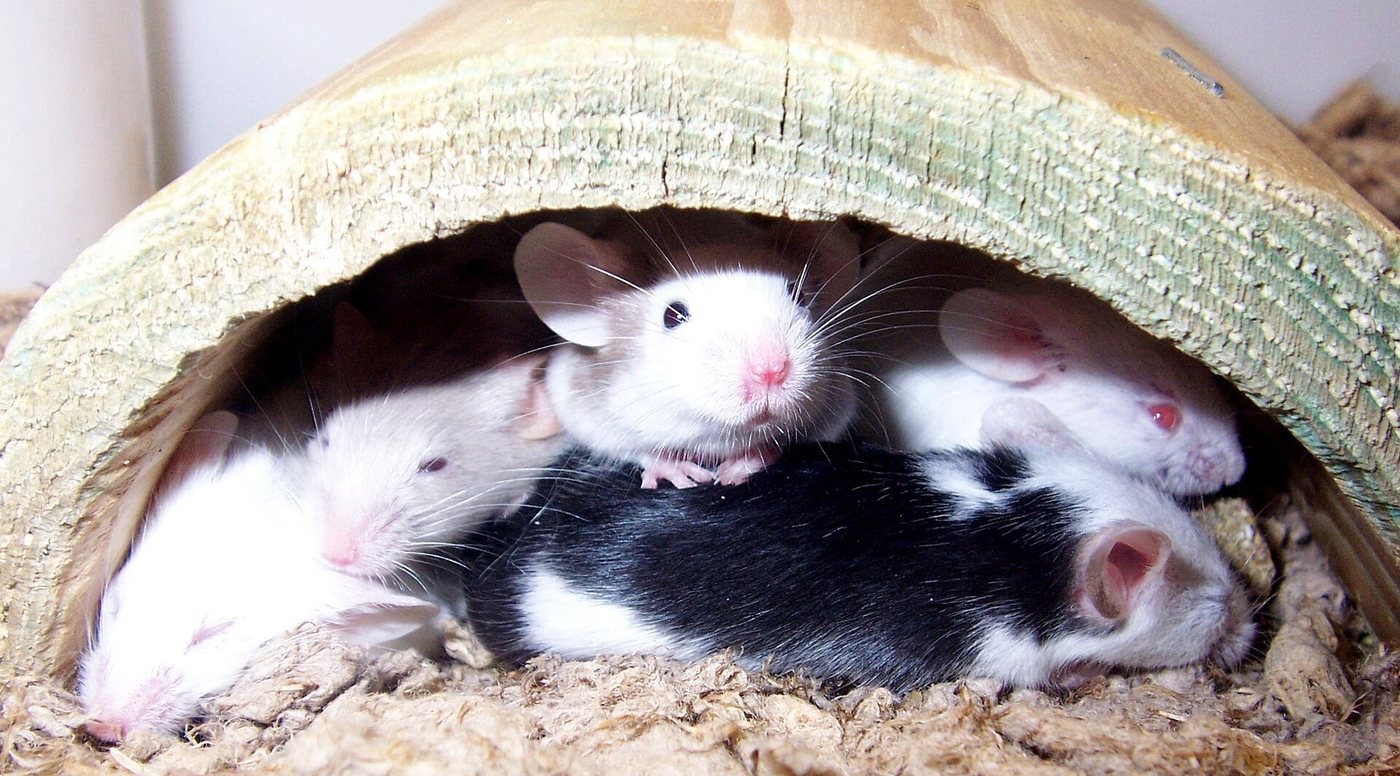
Overview
The fancy mouse is the smallest commitment on this list and one of the most entertaining. The social rules are the mirror image of most rodents: females are the social ones, happiest in busy sisterhoods of three or more; males are loners by biology, territorial to the point of lethal violence, and each needs his own tank. Mice are mostly pets to watch rather than hold — fast, fragile, and forever busy after dark.
Temperament & personality
Shy at first, then bold in bursts. Mice are neophobic about new objects and devoted to routine routes through their cage, which they map with scent. Females in a group develop a bustling social life — shared nests, grooming sessions, and the occasional dramatic argument. Handling tames many mice into walking voluntarily onto a hand, especially if the hand reliably delivers seeds.
Appearance
A tiny, neat rodent with a pointed snout, big round ears, bright bead eyes, and a long, thin tail about as long as its body. The fancy breeding world has produced satin, long-haired, and curly coats and a painter's palette of colours — champagne, dove, chocolate, blue, and broken (patched) patterns. Males and females look alike; males are identifiable by their much stronger smell.
Care & daily life
Feed a mouse pellet or quality seed mix with small amounts of fresh food; scatter-feed so they forage. Provide a solid wheel (17 cm / 6.5 in minimum), tunnels, chew sticks, and deep bedding for nest building. Females can share a 10-gallon tank as a minimum (20 gallons is kinder for a group); males live alone in their own tanks. Handle gently with scooped hands — mice are fragile, and being grabbed from above reads as a predator attack. Never house males together 'to try it': fights can be lethal the first night.
Health & lifespan
The Fancy Mouse is generally known for the following health watch-points:
- Respiratory infections — wheezing and clicking; highly contagious between mice
- Tumours, especially mammary tumours in older females — very common in mice
- Skin mites causing frantic scratching and fur loss
- Barbering — one mouse over-grooming cage-mates bald; a social-ranking behaviour
- Malocclusion of the ever-growing incisors
Living with a Fancy Mouse
Mice suit watchers: a tank of females building nests, running the wheel in shifts, and squabbling over a sunflower seed is a living screensaver. They need small homes to be kind rather than cheap ones — males need a tank each, and their perfume is real. Best for older children and adults with gentle hands and realistic expectations about handling: many mice tolerate hands; few truly relax in them.
History
Mice have been kept and bred for fancy colours for centuries — Chinese and Japanese breeders produced waltzing and pied varieties long before Victorian England made the fancy mouse a hobby, with the National Mouse Club founded in 1895 setting breed standards. Waltzing mice, which circle due to an inner-ear trait, were recorded in Japan centuries ago. The pet mouse and the laboratory mouse are the same species, Mus musculus domesticus.