Overview
The African grey is the intellectual of the parrot world: the finest mimic of human speech, a demonstrated problem-solver, and an emotionally complex bird with the rough cognitive level of a young child. Two types are kept — the larger Congo grey with its scarlet tail and the smaller, darker Timneh. What the fame often hides is the cost: this is a wild-minded, flock-bonded animal that needs hours of social contact every day for up to sixty years, and suffers visibly when it doesn't get it.
Temperament & personality
Greys are observant, thoughtful, and often cautious — new objects, people, and routines are studied before they're trusted. They commonly bond intensely to one person and may be standoffish or jealous with others. Their sensitivity is the flip side of their intelligence: greys read household tension, sulk, and — when chronically bored, lonely, or frightened — may begin plucking their own feathers. A confident, well-socialised grey is witty, affectionate, and astonishing company; the talking, when it comes, often appears in eerily appropriate context.
Appearance
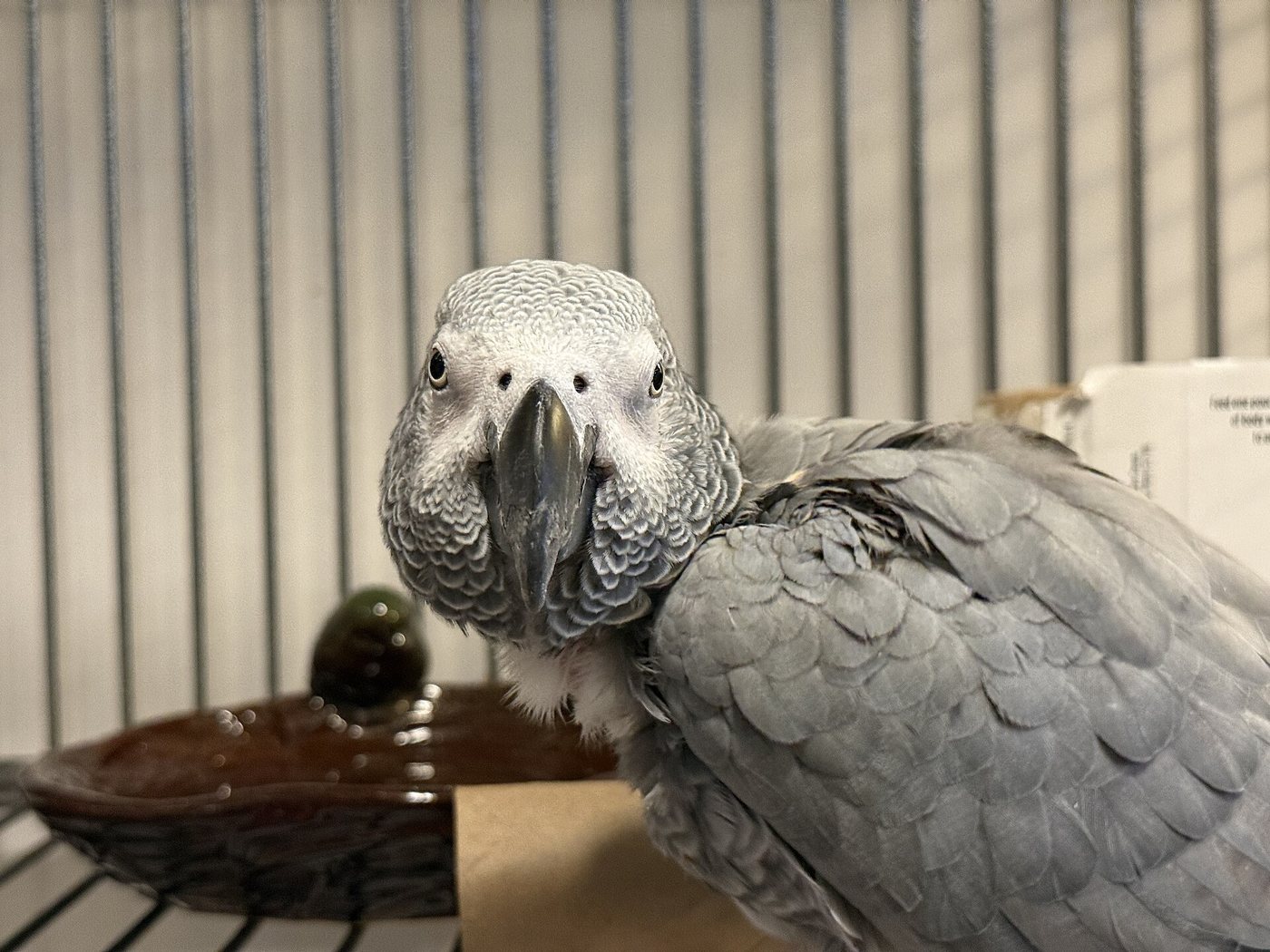
A medium, stocky parrot in soft ash grey, with a pale, almost white face, a black beak, and a tail of startling scarlet (Congo greys) or deep maroon (Timneh greys, which are smaller and darker with a horn-coloured upper beak). The eyes of adults are pale yellow, giving the bird a famously penetrating stare.
Care & daily life
Greys need a large cage (bar spacing ¾–1 inch), several hours out daily, and a household that treats them as a feathered toddler for decades: rotated toys, foraging puzzles, training sessions, and constant social inclusion. Feed a quality pellet base with vegetables, some fruit, nuts, and a little seed as treats. They are sensitive to calcium deficiency, so diet and UV/full-spectrum light matter — discuss supplements with an avian vet. Keep them strictly away from tobacco smoke, aerosols, and non-stick fumes; greys are among the most smoke-sensitive of parrots.
Health & lifespan
The African Grey Parrot is generally known for the following health watch-points:
- Feather-damaging behaviour (plucking) linked to stress, boredom, and loneliness — the species' signature welfare problem
- Hypocalcaemia (low blood calcium), to which greys are unusually prone; can cause tremors and seizures
- Psittacine beak and feather disease (PBFD)
- Aspergillosis and other respiratory diseases; extremely sensitive to smoke and fumes
- Proventricular dilatation disease (PDD)
- Atherosclerosis in older, sedentary birds on fatty diets
Living with a African Grey Parrot
An African grey suits an experienced, home-centred keeper who wants a genuine companion animal for the next half-century: someone home much of the day, patient with a bird that may bond to one person, wary of strangers, and unsettled by change for weeks. It is a poor match for busy, travelling, or noise-sensitive households, and — despite the talking fame — not a novelty pet. Done right, it is one of the most rewarding human-animal bonds there is.
History
African greys inhabit the rainforests and forest edges of West and Central Africa, from the Ivory Coast to western Kenya, roosting communally and feeding in noisy flocks. Their intelligence made them prized companions as far back as ancient Egypt and Rome. Tragically, wild populations have fallen sharply from trapping for the pet trade combined with habitat loss; the species is listed as Endangered, and international trade is tightly restricted — any pet grey should be captive-bred with proper paperwork. Dr Irene Pepperberg's 30-year study of the grey Alex, begun in 1977, transformed scientific understanding of parrot cognition.