Overview
The green-cheeked conure has become the conure for people who thought they couldn't have a conure: all the genus's famous clowning, cuddling, and mischief, at a fraction of the noise of its larger cousins. At about 10 inches it is one of the smallest true conures, yet owners consistently describe a big-bird personality — confident, acrobatic, and determined to be the centre of the household's attention.
Temperament & personality
Green-cheeks are affectionate clowns: they hang upside down, wrestle with toys, burrow into shirts, and nap in cupped hands. They bond strongly and follow their people with real devotion. The honest caveat is the beak — green-cheeks go through a nippy phase and test boundaries with pressure; with calm, consistent training most mature into gentle companions. They are middling talkers at best, speaking in a gravelly murmur, but their physical expressiveness more than compensates.
Appearance
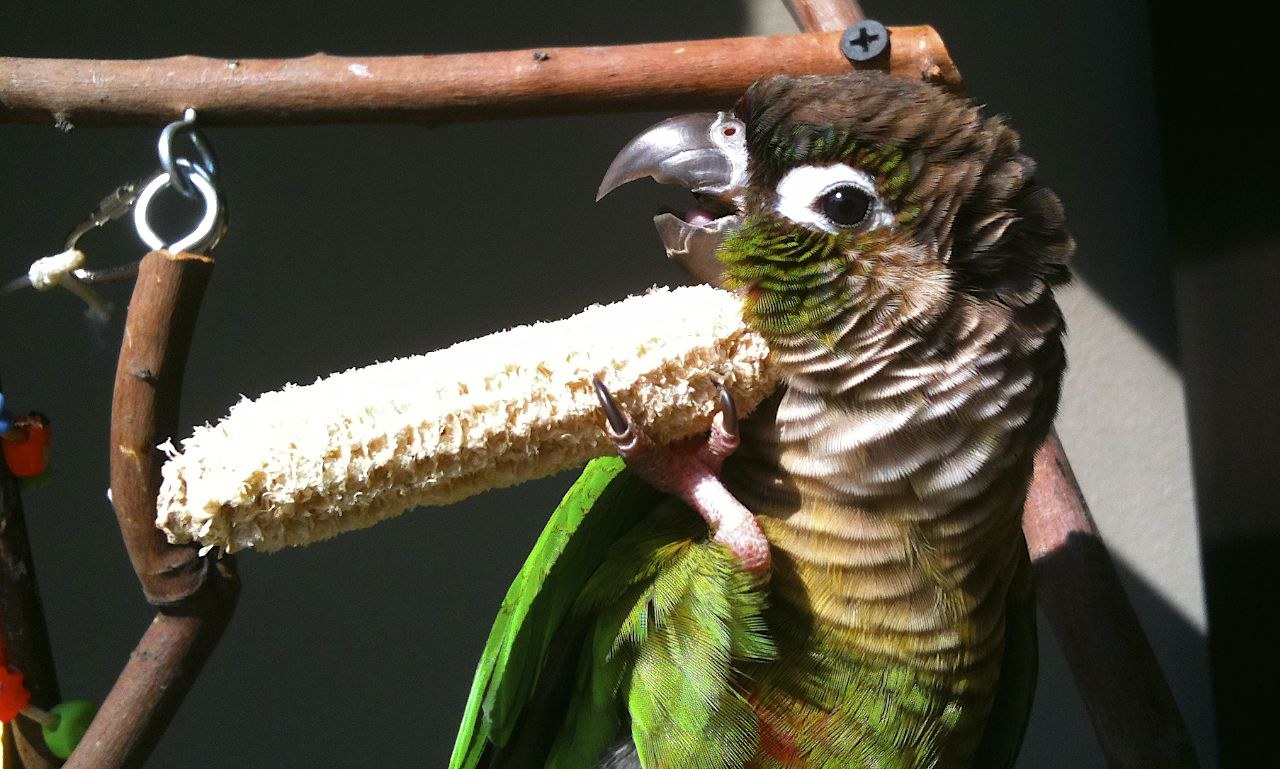
A small, slender conure: rich green body, a maroon tail, blue flight feathers visible in flight, a grey-brown breast with subtle barring, and a dark cap. Several colour mutations are bred in aviculture — yellow-sided, pineapple, cinnamon, and turquoise among them. Adults and juveniles look much alike, and the sexes are visually identical.
Care & daily life
Green-cheeks need a cage of at least about 24 × 24 inches (bar spacing ½–⅝ inch), several hours out daily, and a steady supply of chewable wood and toys — conures demolish toys as a hobby. Feed pellets plus vegetables, fruit, and a little seed. They love bathing and will happily splash in a shallow dish most days. Expect the beak to be used exploratorily: supervision around fingers during the nippy adolescent phase, and positive-reinforcement training from day one.
Health & lifespan
The Green-Cheeked Conure is generally known for the following health watch-points:
- Psittacine beak and feather disease (PBFD) occurs in conures
- Proventricular dilatation disease (PDD)
- Conure bleeding syndrome — a clotting disorder linked to vitamin K and calcium metabolism, seen mainly in some conure species
- Respiratory infections and aspergillosis in poor air quality
- Feather-damaging behaviour when bored or under-socialised
- Injuries from unsupervised out-of-cage time — this is a bold, busy bird
Living with a Green-Cheeked Conure
Green-cheeks suit parrot lovers who want conure character without conure volume: singles, couples, and families with respectful children, in houses or reasonably tolerant apartments. The commitment is 20–30 years of daily out-of-cage time, training, and toy replacement — a part-time job measured in decades. They are a genuinely good first step into the conure family, provided the nippiness phase is expected and handled calmly.
History
Green-cheeked conures come from the forests and woodland edges of south-central South America — northeastern Argentina, Paraguay, Bolivia, and Brazil — where they travel in flocks of 10–20 birds. They entered aviculture widely in the late 20th century and captive breeding has produced colour forms never seen in the wild, including the popular pineapple and turquoise mutations. Their rise as pets is recent and rapid, driven by their reputation as the 'beginner conure.'