Overview
The Quaker parrot — monk parakeet to science — is the engineer of the parrot family: the only parrot that builds, weaving enormous communal stick nests instead of renting tree holes. It is also one of the most gifted small talkers, hardy enough to survive a Chicago winter, and charming enough to win over whole households. The flip side is written into law: those same traits make escaped Quakers successful invaders, and several US states ban or restrict keeping them outright. A Quaker profile that doesn't start with legality isn't an honest one.
Temperament & personality
Quakers are busy, bold, and opinionated: builders, talkers, and comedians with a strong sense of household membership. They bond closely, learn speech readily and often deploy it aptly, and busy themselves with weaving and rearranging. The shadow side is territory — a Quaker, especially a hen, may defend its cage like the nest it believes it to be, lunging at hands that reach in. Owners who respect the fortress and socialise the bird outside it get a loyal, hilarious companion; everyone agrees the chatter never really stops.
Appearance
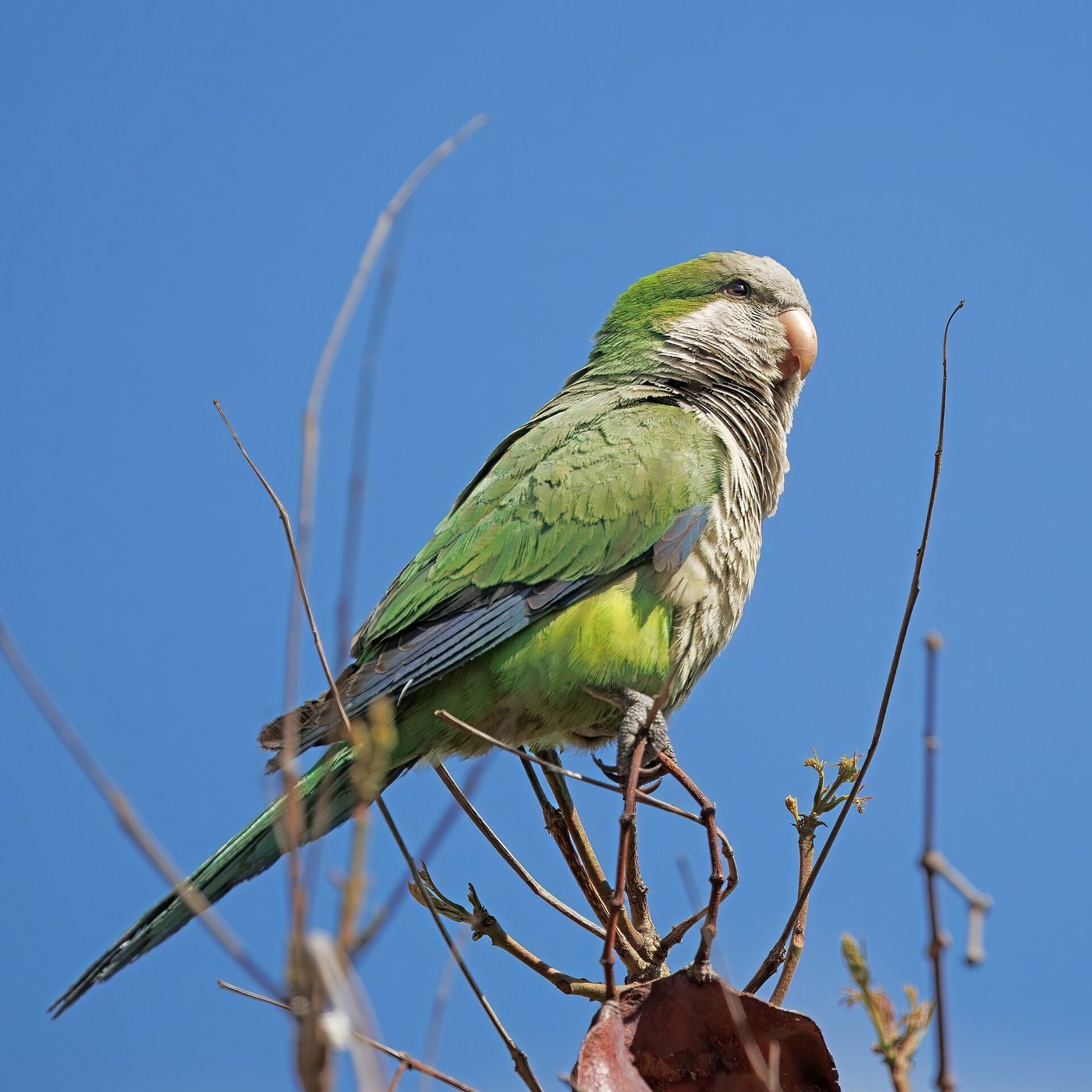
A stocky little parrot in soft green above and pale grey on the forehead, cheeks, throat, and scalloped breast — the grey 'bib' that gives it the monk's-cowl or Quaker-grey look. Flight feathers flash blue in flight. The beak is pale and horn-coloured. At 11–12 inches it has the proportions of a small conure with a longer tail; albinos, lutinos, and blues are bred in aviculture. Wild-type birds are camouflaged birds — the colour is canopy, not costume.
Care & daily life
First, check the law — see the Living section; Quakers are illegal or restricted in several US states and some other jurisdictions. Where legal: a cage of at least 24 × 24 × 24 inches (bar spacing ½–⅝ inch), hours out daily, and a household ready for a busy, weaving, nest-building bird — supply shreddable material and expect construction projects. Quakers are famously cage-territorial, especially hens, so stick-training and out-of-cage socialising keep hands safe. Feed pellets with generous vegetables, leafy greens, and some fruit; watch weight, as the species gains easily. Chatter is constant and contact-calling frequent; they are not library birds. Their cold tolerance is real (feral colonies survive Chicago winters), but pet birds still need draught-free housing.
Health & lifespan
The Quaker Parrot (Monk Parakeet) is generally known for the following health watch-points:
- Quaker mutilation syndrome — a distressing species-specific condition in which the bird chews at its own skin and feathers, mainly on the chest; needs an avian vet and behaviour work
- Fatty liver disease and obesity — Quakers gain weight readily on seed-heavy diets
- Feather-damaging behaviour when bored or socially neglected
- Psittacine beak and feather disease (PBFD)
- Egg binding in hens
- Respiratory disease in poor air quality
Living with a Quaker Parrot (Monk Parakeet)
Where they are legal, Quakers suit keepers who want a big-parrot brain and talking talent in a conure-sized, apartment-plausible (if not quiet) package, with 20–30 years of daily companionship. The checks are legal and acoustic: confirm state and local law first — California, Pennsylvania, New Jersey, Connecticut, Hawaii, and Kentucky are among the states that ban or restrict them, and the list shifts — and know that a Quaker household is a chattering one. They are a poor choice where illegal (obviously), for renters who may move across state lines, or for anyone who might be tempted to release an unwanted bird.
History
Monk parakeets are the great exception-builders of the parrot world: alone among parrots, they construct huge communal stick nests — apartment-block structures on trees, pylons, and utility poles — rather than nesting in holes. Native to the temperate grasslands of Argentina and neighbouring countries, they were exported in huge numbers through the 20th century; escaped and released birds established feral colonies from New York and Chicago to Madrid and Brussels, surviving snowy winters that kill other escaped parrots. Those colonies — crop damage, nests shorting power infrastructure — are precisely why several jurisdictions ban or restrict keeping them.