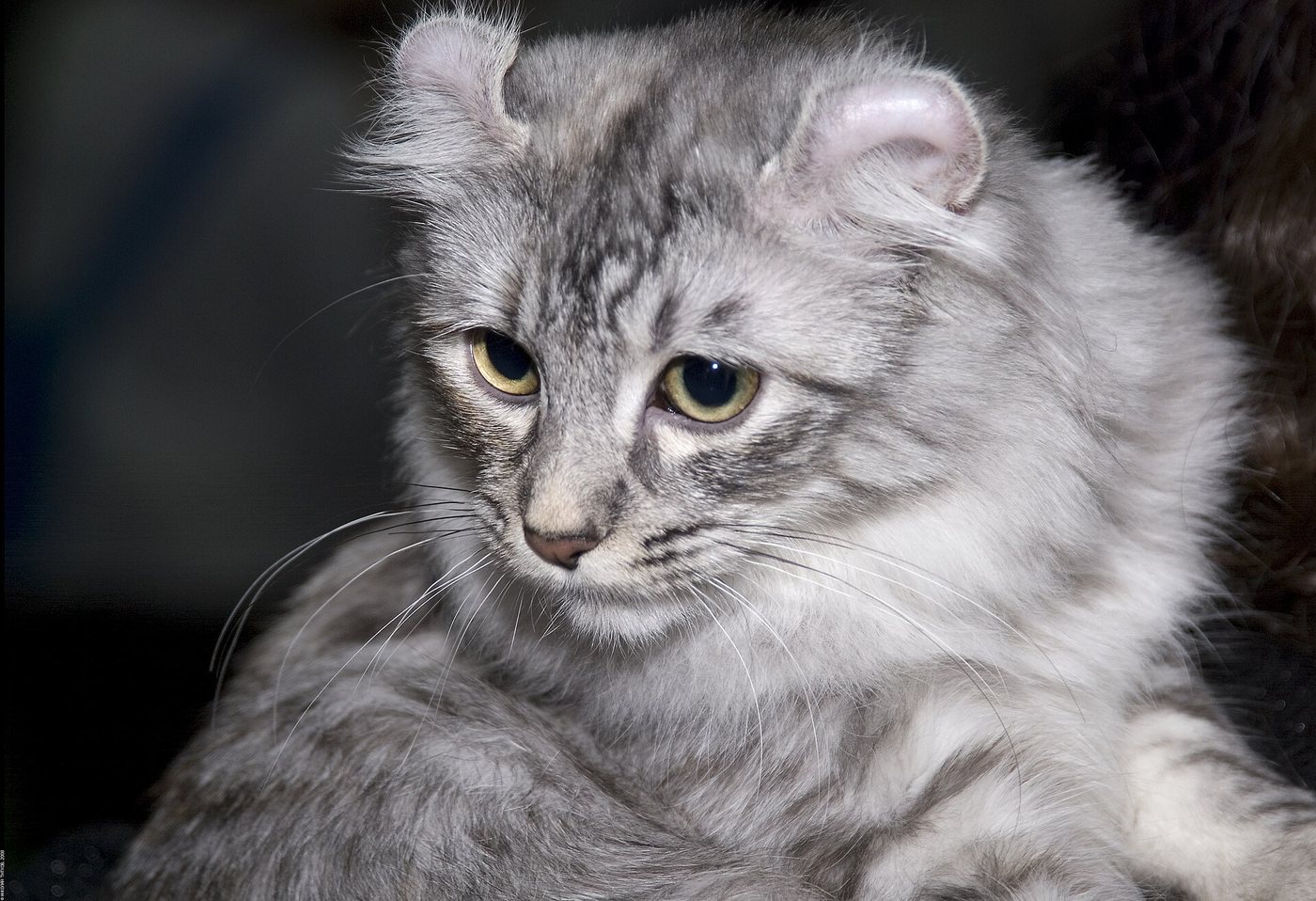
Overview
The American Curl is the cat with the designer ears — a graceful backward curl that gives the breed a perpetually surprised, smiling expression. Beneath the novelty is one of the easiest cats in the pedigree world: affectionate, adaptable, healthy, and famously slow to grow up, earning the nickname 'the Peter Pan of cats.' The breed was developed carefully from a single found stray, outcrossed widely to keep it sound. If you want an unusual-looking cat whose personality is pure, uncomplicated devotion, the Curl delivers.
Temperament & personality
Affectionate, curious, and people-oriented without being pushy. Curls follow their owners, supervise activities, and greet guests, but they are rarely demanding or noisy — conversation comes in soft trills. They stay playful and kittenish well into adulthood, are patient with children, and fit themselves around a household's rhythm with unusual ease. Think less 'aloof feline' and more 'small, gentle shadow with remarkable ears.'
Appearance
The American Curl is unmistakable: a medium, elegant cat whose ears curl backward in a smooth arc of 90 to 180 degrees, framing a sweet, open expression and large walnut-shaped eyes. Kittens are born with straight ears that begin curling within the first week and take their final set by about four months. The body is moderately long and muscular, and the coat — shorthair or semi-longhair, in any colour — is silky with very little undercoat. At least three generations of outcrossing kept the silhouette natural rather than extreme.
Care & daily life
Handle the ears with real gentleness: the cartilage is firm but fragile, and ears must never be pulled, folded, or bent backward, as rough handling can permanently damage them. Check the ears weekly — the breed's narrower ear canals can trap wax — and clean only the visible outer ear with a vet-approved cleaner. The silky coat needs just a comb-through once or twice a week and rarely mats. Add daily interactive play and routine dental care, and the Curl asks for little else.
Health & lifespan
The American Curl is generally known for the following health watch-points:
- One of the healthiest pedigree breeds — founded on a wide pool of domestic cats, with no widespread inherited disease
- Ear canals can be narrower than average, predisposing the breed to wax build-up and ear infections; regular gentle checks are part of ownership
- The ear cartilage is delicate: mishandling, pulling, or forcing the ears backward can cause permanent damage — a handling issue, not a disease
- Some breeders screen for hypertrophic cardiomyopathy (HCM) by ultrasound as a general precaution
- Otherwise robust — most Curls need nothing beyond routine vaccination, dental, and parasite care
Living with a American Curl
American Curls fit almost any household — families, singles, apartments, first-time owners. They are people-centred without being demanding, greeters rather than hiders, and they adapt well to other pets. They should live indoors, and their ears make one household rule non-negotiable: small children must be taught from day one that ears are looked at, never played with. Given gentle handling and company, a Curl is a charming, low-fuss companion.
History
In June 1981, two stray kittens with strange curled ears appeared on the doorstep of Joe and Grace Ruga in Lakewood, California. The Rugas kept one — a black semi-longhair they named Shulamith — and when her kittens arrived, half had curled ears: the trait is a simple dominant gene. Every American Curl alive descends from Shulamith. Local breeders took up the novelty seriously, deliberately outcrossing to ordinary domestic cats to keep the gene pool wide, and the breed was recognised by TICA in the 1980s and by CFA in the following decade. That broad foundation is why the Curl remains one of the healthiest breeds in the fancy.