Overview
The Burmese may be the most companionable cat breed in existence: a small, dense, satin-coated cat that wants to be involved in absolutely everything its humans do. Burmese follow you from room to room, supervise cooking, sit in on conversations, sleep under the covers, and retain a kittenish love of games well into their senior years — which, in this notably long-lived breed, can be a very long time indeed. If you want a cat that behaves almost like a devoted little dog, the Burmese is the benchmark.
Temperament & personality
Outgoing, playful, and intensely people-oriented. Burmese are confident with visitors, tolerant of children, and famously fond of laps, shoulders, and warm spots next to their favourite humans. Males are often described as slightly more laid-back, females as busier and more opinionated, but both sexes share the breed's defining trait: humans are the centre of their world. They do not do solitude well and are happiest in busy, interactive households.
Appearance
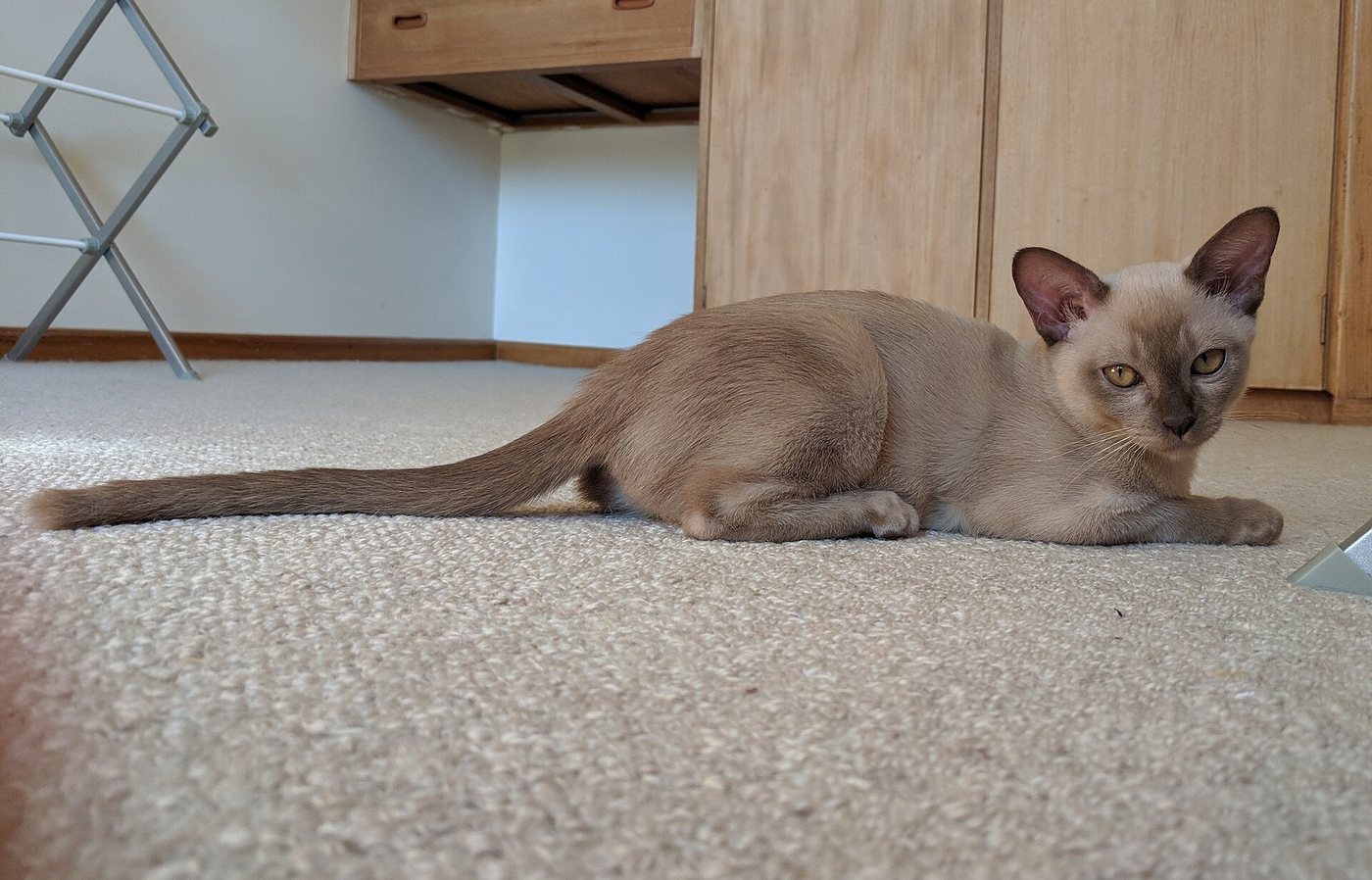
The Burmese is a compact, muscular cat famous for feeling far heavier than it looks — 'a brick wrapped in silk' is the classic description. The coat is short, satin-smooth, and glossy, lying close to the body. The original colour is a rich sable brown; modern breeding has added blue, champagne, and platinum shades. The head is rounded with a short muzzle, a strong chin, and large, expressive golden eyes that give the breed its alert, almost surprised expression.
Care & daily life
The Burmese coat is one of the easiest in the cat world: a weekly once-over with a soft brush or grooming glove removes loose hair and keeps the satin sheen. What this breed demands is not grooming time but *your* time — daily interactive play, involvement in household life, and ideally another animal companion if you work long hours. They are athletic and curious; cat trees, window perches, and rotating toys help. Watch food portions carefully, as Burmese gain weight readily indoors.
Health & lifespan
The Burmese is generally known for the following health watch-points:
- Burmese hypokalemia (hypokalaemia) — an inherited low-potassium condition causing episodic muscle weakness; a DNA test exists and breeders should screen
- Diabetes mellitus — Burmese show a higher incidence than most breeds, particularly in some populations; weight management matters
- Hypertrophic cardiomyopathy (HCM) occurs; ultrasound screening is used by responsible breeders
- Burmese head defect — a severe craniofacial deformity in kittens, linked to selection for extremely rounded heads in some lines; ethical breeders avoid the mating combinations that produce it
- Obesity is a common everyday issue and worsens diabetes risk
Living with a Burmese
Burmese suit almost any home where someone is around a good part of the day — families, singles with home-based routines, and multi-pet households all work. They are a poor choice for a house that stands empty for long hours; a lonely Burmese is a miserable one, and many owners keep them in pairs for exactly that reason. They are generally indoor cats, too trusting and people-focused for the street, and they repay company with constant, cheerful involvement in everything you do.
History
The modern Burmese descends from a single walnut-brown female named Wong Mau, brought from Burma to San Francisco in 1930 and bred by Dr Joseph Thompson. Her kittens established the rich sable breed, which the CFA recognised in 1936. The breed split into two looks over the decades: the rounder American Burmese and the more moderate European Burmese, now treated as related but distinct standards in some registries. What never changed is the temperament — the Burmese was a people's cat from the start.