Overview
The Cornish Rex is a cat in a velvet tracksuit: fine-boned, athletic, and covered from ears to tail tip in soft, rippling waves. Having no guard hairs at all gives the coat its extraordinary texture — stroking one is often compared to touching warm suede — and gives the cat its greyhound silhouette. In temperament, Cornish Rexes are famously kittenish for life: racing around the house, playing fetch, riding shoulders, and seeking the warmest lap with complete determination.
Temperament & personality
Active, affectionate, and hilariously self-confident. Cornish Rexes are extroverts that greet visitors, join games, and involve themselves in everything, usually at speed. They bond deeply with their people, follow them about chatting, and dislike being left out or left alone for long. Despite the energy, they are dedicated cuddlers in rest mode — ideally under a blanket, against a human radiator. Think of the breed as a playful toddler in cat form, for fifteen-plus years.
Appearance
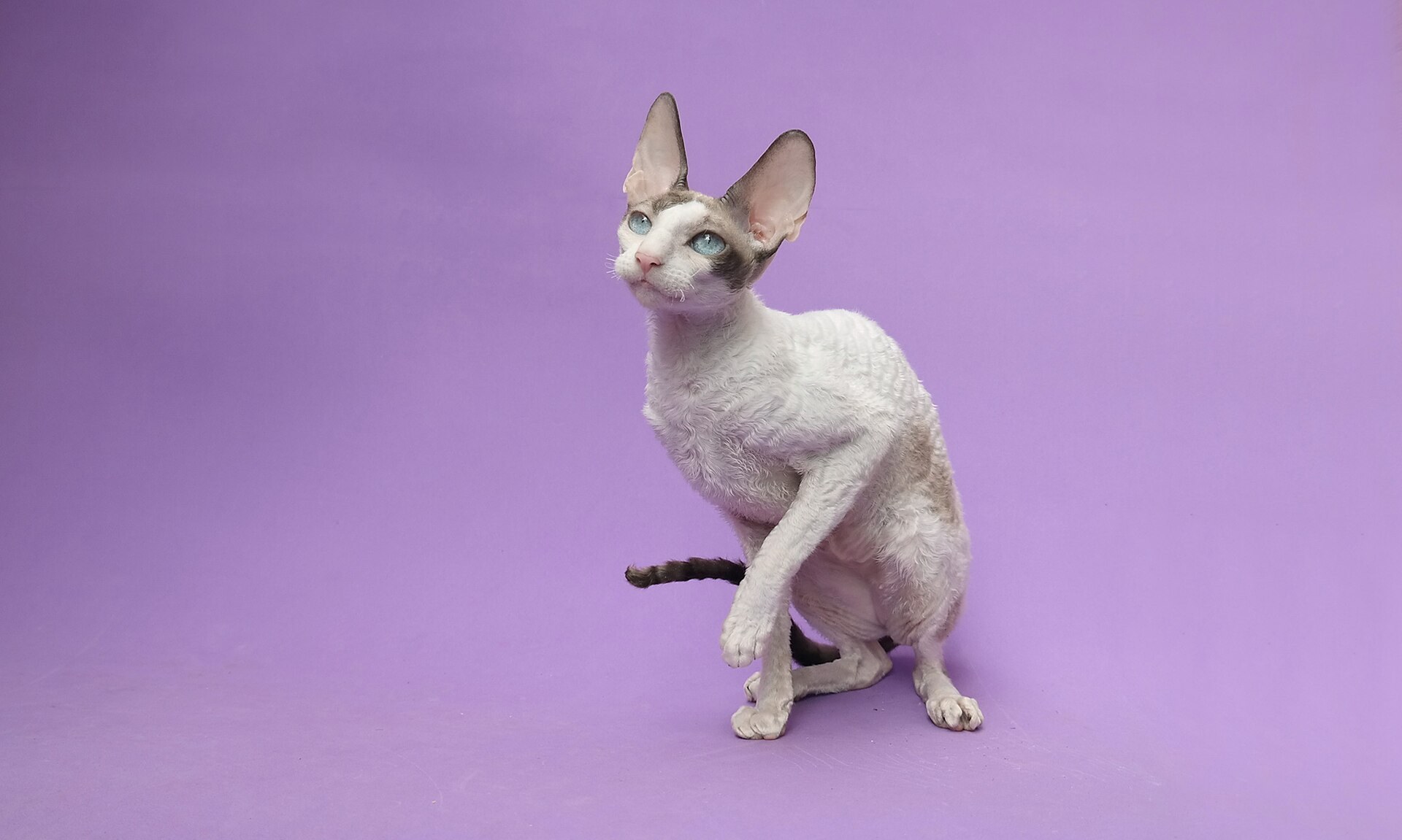
The Cornish Rex has a distinctive 'egg-shaped' head with high cheekbones, a Roman nose, and very large, high-set ears on a fine-boned, surprisingly muscular body — often described as the greyhound of the cat world. The coat is the marvel: extremely short, fine, and silky, falling in uniform waves or ripples (a 'Marcel wave' effect) because the breed completely lacks the outer guard hairs of a normal coat. It feels like warm suede or crushed velvet. All colours and patterns occur.
Care & daily life
Grooming is minimal — a gentle rub with a soft cloth or your hands keeps the delicate coat in order; harsh brushing can damage it. The fine coat means Cornish Rexes feel temperature keenly: they are heat-seeking indoor cats that need warm beds, and their exposed skin can sunburn, so they should not live outdoors. Large ears need routine wax checks. They are athletic, high-energy cats that need climbing furniture, play sessions, and food puzzles; their appetites are famously hearty, so portions need watching despite the slim build.
Health & lifespan
The Cornish Rex is generally known for the following health watch-points:
- Hypertrophic cardiomyopathy (HCM) — occurs in the breed; ultrasound screening of breeding cats is recommended
- Patellar luxation is reported, consistent with the breed's fine build
- Skin realities: with no guard hairs, the skin is exposed — sunburn is a genuine risk, the coat feels oily to some owners, and the cats feel cold easily; indoor living and warmth are health measures
- Umbilical hernias were historically associated with the early breed and are screened for in kittens
- Progressive retinal atrophy (PRA) — a DNA test exists and is used in breeding programs
Living with a Cornish Rex
Cornish Rexes are indoor cats for warm, interactive homes — they want laps, radiators, games, and an audience. They fit families with playful children, multi-cat homes, and apartment living well, because their needs are company and activity rather than space. Owners who travel constantly or want an aloof, independent cat should look elsewhere: a Cornish Rex will treat your suitcase as a bed and your dinner as a shared event. Given warmth and attention, they are affectionate, amusing companions for a long lifespan.
History
In 1950, on a farm near Bodmin in Cornwall, a cream male kitten named Kallibunker was born with a short, tightly curled coat unlike anything his normal-coated mother produced. His owner, Nina Ennismore, recognised the similarity to rex rabbits and, advised by geneticists, bred Kallibunker back to his mother — producing more curly kittens and proving a recessive mutation. Every Cornish Rex today descends from Kallibunker. The breed nearly died out in Britain in the 1950s and was rebuilt with cats exported to North America, where it gained full recognition.