Overview
The Toyger is proof that a cat breed can be pure theatre and a genuinely good pet at the same time: the coat aims for tiger, the cat underneath is a friendly, manageable, thoroughly domestic companion. Developed since the 1980s from Bengals and a striped housecat, it offers exotic looks with none of the legal, dietary, or behavioural complications of actual hybrids — no wild blood, no special permits, no serval-sized demands. What it asks instead is money and patience: the breed is still rare, still being perfected, and priced accordingly.
Temperament & personality
Friendly, confident, and agreeably laid-back. Toygers are social cats who enjoy people, play, and participation, without the intensity or noise of their Bengal relatives. They are intelligent and trainable — leash walking, fetch, and trick training all come readily — and many share the Bengal family's curiosity about water. With children and other pets they are generally easy-going and robust, making them one of the simplest of the 'wild look' breeds to actually live with.
Appearance
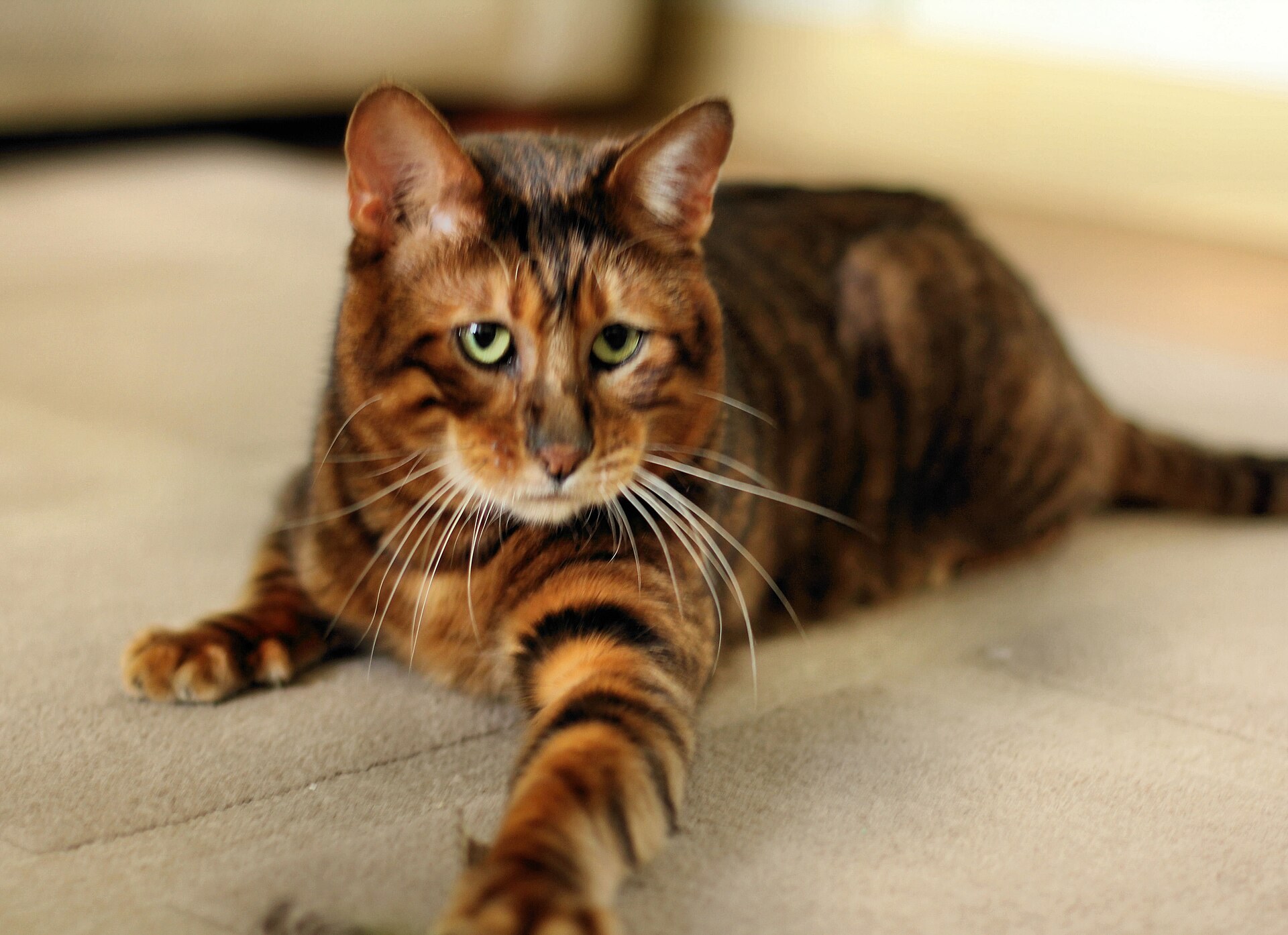
The Toyger is a domestic cat in tiger costume: a medium-to-large, muscular, long-bodied frame under a short, plush coat patterned with bold, dark, vertical stripes — ideally branching and interlocking like a tiger's, on a rich orange-gold ground. Later breeding has added rosetted markings influenced by the Bengal side of its ancestry. The head is medium-sized with a strong chin, smallish rounded ears, and bright eyes under a purposeful brow; many Toygers carry the Bengal 'glitter' gene, so the coat sparkles in sunlight. Crucially, every millimetre of it is domestic cat — there is no tiger, or any wild species, in the pedigree.
Care & daily life
Toygers are easy keepers: the short coat needs a weekly brush and sheds modestly, and their temperament makes handling, vet visits, and even leash walks straightforward. They are athletic and playful, so give them tall perches, tunnels, and daily interactive play, plus the puzzle toys their quick brains enjoy. Many Toygers take happily to harness training and some even to water play — Bengal heritage again. Feed to condition; this is a muscular breed that should look powerful, not pudgy. As a young breed still being developed, choose breeders who health-screen and who are candid about their lines.
Health & lifespan
The Toyger is generally known for the following health watch-points:
- A young, still-developing breed, so the honest headline is limited long-term data rather than a clean bill or an alarming one
- Hypertrophic cardiomyopathy (HCM) is the condition breeders watch, given Bengal ancestry; ask whether breeding cats receive heart ultrasounds
- Progressive retinal atrophy occurs in the wider Bengal family; ask breeders what screening, if any, they use
- No Toyger-specific inherited disease has been established — buy from breeders who screen anyway and publish their results
Living with a Toyger
Toygers are designed to be easy to live with: friendly, confident, and sociable, they fit families, multi-pet homes, and active singles, and they generally take children, dogs, visitors, and harness walks in their stride. They need the normal athletic cat's share of climbing and play, and they thrive on company and involvement. Their main barrier is practical rather than temperamental — price and availability — and buyers should expect to join a waiting list for a well-bred kitten.
History
The Toyger is the project of one breeder's imagination: in the late 1980s in California, Judy Sugden — whose mother Jean Mill founded the Bengal breed — noticed that her striped domestic shorthair, Scrapmetal, had unusually clear facial markings and two distinct spots suggesting stripes could be refined. Crossing Bengals with boldly striped domestic shorthairs, she set out to reproduce a tiger's pattern — vertical, branching stripes on orange — in a wholly domestic, good-tempered cat. TICA registered the Toyger in 2000 and granted championship status in 2007. Development continues: breeders are still working toward whiter undersides, more circular head patterns, and smaller ears, making the Toyger a genuine breed-in-progress and explaining its scarcity and price.