Overview
The Gordon Setter is the heavyweight of the setter family: a handsome black-and-tan gundog bred to work grouse moors all day in Scottish weather. Slightly more serious and guardedly loyal than its English and Irish cousins, the Gordon combines a bird dog's athleticism and nose with a deep devotion to its family — a lot of dog, in every sense.
Temperament & personality
Bold, confident, and intensely loyal, Gordons bond closely and can be one-family dogs, reserved until a stranger is properly introduced. They are intelligent and strong-willed; training must be consistent and positive, and they mature slowly, staying puppyish well into their second year. With their people they are affectionate, demonstrative, and fond of being involved in everything.
Appearance
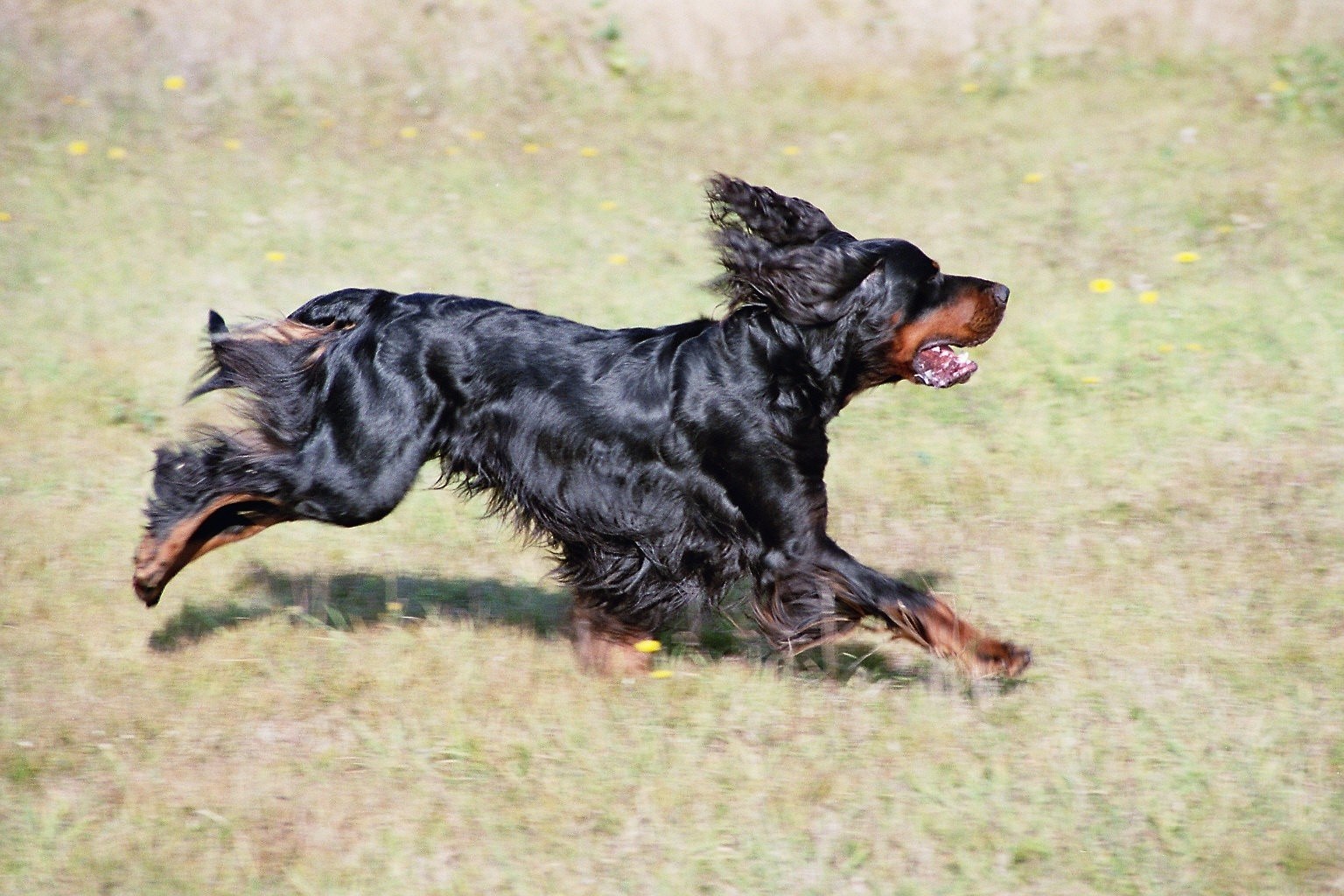
The only black-and-tan setter: a substantial, elegant gundog with a long, silky, flat coat in jet black with rich tan markings over the eyes, on the muzzle, throat, chest, legs, and under the tail. Feathering flows on the ears, chest, legs, and tail, and the expression is dignified and intelligent.
Care & daily life
Gordons are athletes: budget one and a half to two hours of exercise daily, ideally with real running. The silky coat needs brushing two or three times a week to keep feathering free of tangles, plus regular ear checks — those long, feathered ears trap moisture. Young Gordons mature slowly and benefit from patient, steady training rather than drilling.
Health & lifespan
The Gordon Setter is generally known for the following health watch-points:
- Hip dysplasia
- Bloat (gastric dilatation-volvulus) — deep-chested setters are at risk
- Progressive retinal atrophy (rcd4), a late-onset inherited blindness — DNA-testable
- Hypothyroidism
- Elbow dysplasia and certain cancers occur in the breed
Living with a Gordon Setter
Gordons belong with active families who have room — a house with a proper garden or easy access to open country. They are devoted, home-loving dogs that do poorly with long daily isolation, and their exercise and grooming needs rule out a low-effort household. Rural and suburban life suit them best.
History
Black-and-tan setters were worked on Scottish estates for centuries, but the breed was shaped into its modern form at Gordon Castle by Alexander Gordon, 4th Duke of Gordon, in the late 1700s and early 1800s. Built for endurance on grouse moors rather than raw speed, Gordons crossed the Atlantic early — George Blunt imported foundation dogs to the United States in 1842 — and the AKC recognised the breed in 1892.