Overview
No fish carries more personality per inch than the betta — or more misinformation. Shop bettas sit in cups because they must be separated and because the trade profits from the myth that they prefer tiny homes. In truth a betta is an intelligent, territorial surface-dweller from Thailand's warm rice paddies that learns its keeper, builds bubble nests, and patrols its territory like a tiny landlord. Give one a proper heated, planted tank and it becomes less an ornament than a pet.
Temperament & personality
Bold, curious, and theatrical. A male betta flares at rivals, reflections, and sometimes simply the concept of the neighbouring tank; he also learns feeding routines within days, begs at the surface, and may rest theatrically on leaves like a fainting Victorian. Temperament varies genuinely between individuals — some tolerate tankmates and shrimp, others declare war on a snail — which is why betta keeping always includes a backup-container plan.
Appearance
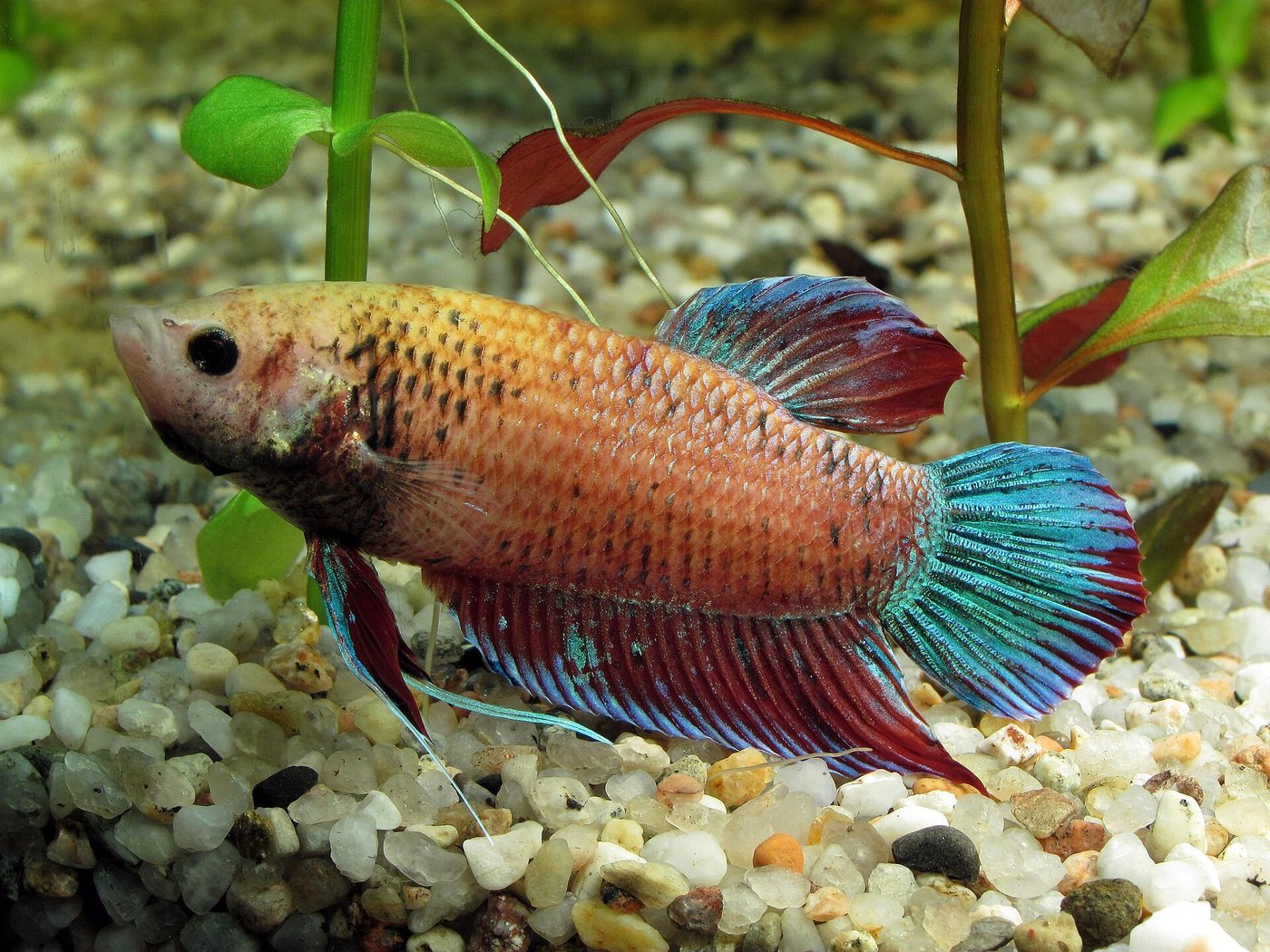
The domestic betta is a study in excess: a small body trailing enormous, flowing fins bred far beyond the wild fish's modest plumage. Males carry the full display — veiltails, crowntails (spiky fringes), halfmoons that flare into a 180-degree fan, double tails, and plakat short-fins — in saturated reds, blues, turquoise, and marbled koi patterns that can shift colour over the fish's life. Females are smaller-finned and subtler but often just as vividly coloured. A flaring male, gill covers flared and fins spread, is one of the great sights of the hobby.
Care & daily life
A betta needs what the cup denies: at minimum 5 gallons of filtered, heated water at 75–80°F, a lid (they jump), and gentle filtration — strong currents exhaust those ornamental fins. Decorate with live or silk plants and a resting leaf near the surface, and avoid sharp plastic that tears fins. Feed a quality betta pellet as the staple with frozen bloodworms, daphnia, or brine shrimp in rotation; the stomach is roughly the size of the fish's eye, so two small meals beat one big one. Weekly partial water changes, and never a full teardown-and-scrub, keep the chemistry stable. Choose tankmates, if any, with care: nothing that nips fins, nothing colourful and long-finned enough to read as a rival.
Health & lifespan
The Betta is generally known for the following health watch-points:
- Fin rot — ragged, darkening fin edges, usually a water-quality problem first and an infection second
- Ich (white spot) and velvet — parasitic dustings that exploit stressed, cold fish
- Swim bladder disorder — floating, sinking, or tipping, often linked to overfeeding and constipation
- Dropsy — pinecone-scaled swelling signalling organ failure; often fatal
- Bloating from oversized meals; a betta's stomach is about the size of its eye
Living with a Betta
Bettas suit beginners who will give them a real tank, aquascapers (a planted betta tank is a jewel box), and anyone wanting a fish with genuine pet qualities in a small footprint. The honest commitment is modest — one fish, 5–10 gallons, daily feeding, weekly water change — but non-negotiable on heat and filtration. They are a poor choice as an office decoration in a vase, and a worse one as a child's unsupervised first pet in a cup.
History
Wild bettas are drab green-brown fish of Thailand's rice paddies and slow streams. In Siam (now Thailand) they were domesticated well over a century ago and bred for aggression — 'pla kat' bouts were a gambling sport patronised by royalty — before Western breeders pivoted to breeding for colour and finnage instead. The result is a domestic fish so transformed that it barely resembles its ancestors, and so popular it anchors the small-tank hobby worldwide.