Overview
The eastern box turtle is not an aquatic turtle that wandered ashore — it is a true land turtle, a dome-shelled woodland animal with a hinge across its plastron that lets it close itself into a sealed box no raccoon can open. It lives its whole life, which may span half a century, within a home range smaller than a football field, learning every log and berry bush. That fidelity is its tragedy in the modern world: box turtles are declining across their range, and a turtle 'rescued' to a new place will spend its remaining years trying to walk home.
Temperament & personality
Box turtles begin shy — the box closes, the world waits — and become, over months and years, quietly personable: they learn feeding spots, recognise their keeper, and emerge expectantly at the sound of the worm bucket. They have genuine daily rhythms, soaking in the morning, foraging after rain (earthworm weather is their festival), and burrowing into leaf litter at night. They are not social in any useful sense and males can bully; most keepers house them singly or in spacious outdoor pens where avoidance is possible.
Appearance
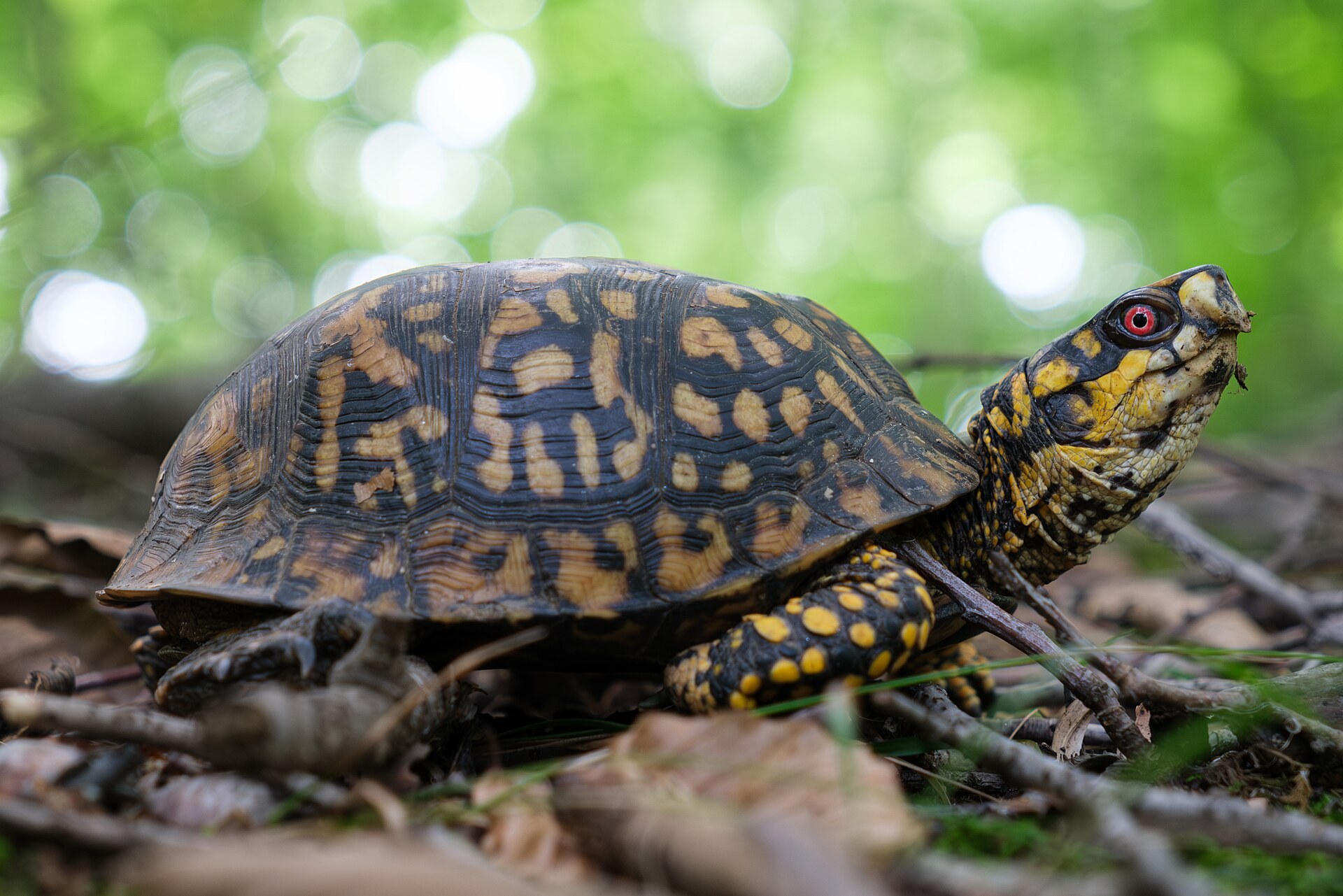
Each eastern box turtle wears a unique pattern: a high, domed carapace of dark brown or black, each scute painted with yellow-to-orange blotches, streaks, or radiating lines — no two alike, a fingerprint in shell. The plastron is hinged, letting the turtle seal both ends completely. Males typically have red or orange eyes and brighter markings; females' eyes are brown or yellow. The feet are elephantine at the back — this is a walking turtle, not a swimmer, and it can drown in deep water.
Care & daily life
An outdoor pen in a suitable climate is the best life humans can offer a box turtle: at least 4×2 ft (more is better), walled against digging out and climbing, with deep soil and leaf litter for burrowing, plant cover, a sunny basking corner, and a shallow pan of water for soaking — never a deep pond. Indoors, replicate the woodland floor: 4×2 ft or larger, soil substrate kept damp at depth, humidity of 60–80%, a basking spot of 85–90°F, UVB, and hides. Feed like the omnivore it is: earthworms, slugs, beetles, and other invertebrates for roughly half the diet, with dark leafy greens, squash, berries, and mushrooms making up the rest; dust with calcium. The ethics matter with this species: wild box turtles are protected or regulated in many states and taking one from the wild both harms a declining species and condemns a territorial animal to lifelong displacement — buy captive-bred, or admire wild ones exactly where you found them.
Health & lifespan
The Eastern Box Turtle is generally known for the following health watch-points:
- Ear (aural) abscesses — a classic box turtle illness: a swelling on the side of the head, linked to vitamin A deficiency and poor conditions
- Respiratory infections — bubbly nose, wheezing, closed eyes; often follows cold, dry, or dusty housing
- Vitamin A deficiency — swollen, shut eyes and poor appetite
- Shell rot and shell injuries (cars, mowers, and dogs are leading wild killers)
- Internal parasites, especially in wild-caught animals
Living with a Eastern Box Turtle
Eastern box turtles suit patient, settled keepers — ideally with a garden for an outdoor pen — who want a pet measured in decades and are content with a relationship built on routine rather than handling. The 30–50 year lifespan, the outdoor-first housing, and the species' protected status all argue for deliberation: adopt captive-bred, keep any wild encounter wild, and site the pen as a permanent feature. They are not pets for renters on the move or for small indoor tanks.
History
Terrapene carolina carolina has walked the eastern American woodlands since long before there were suburbs in them, and it was once among the most familiar reptiles on the continent — the turtle in every meadow and garden. The 20th century was hard on it: habitat fragmentation, road mortality, collection for the pet trade, and the closing of its woodland corridors have driven declines severe enough that the species is now listed as Vulnerable, with many states protecting it. Because adults hold tiny lifelong territories, populations cannot simply move elsewhere — each lost turtle is a permanent local loss. Captive-bred animals exist and are the only ethical source for pets.