Overview
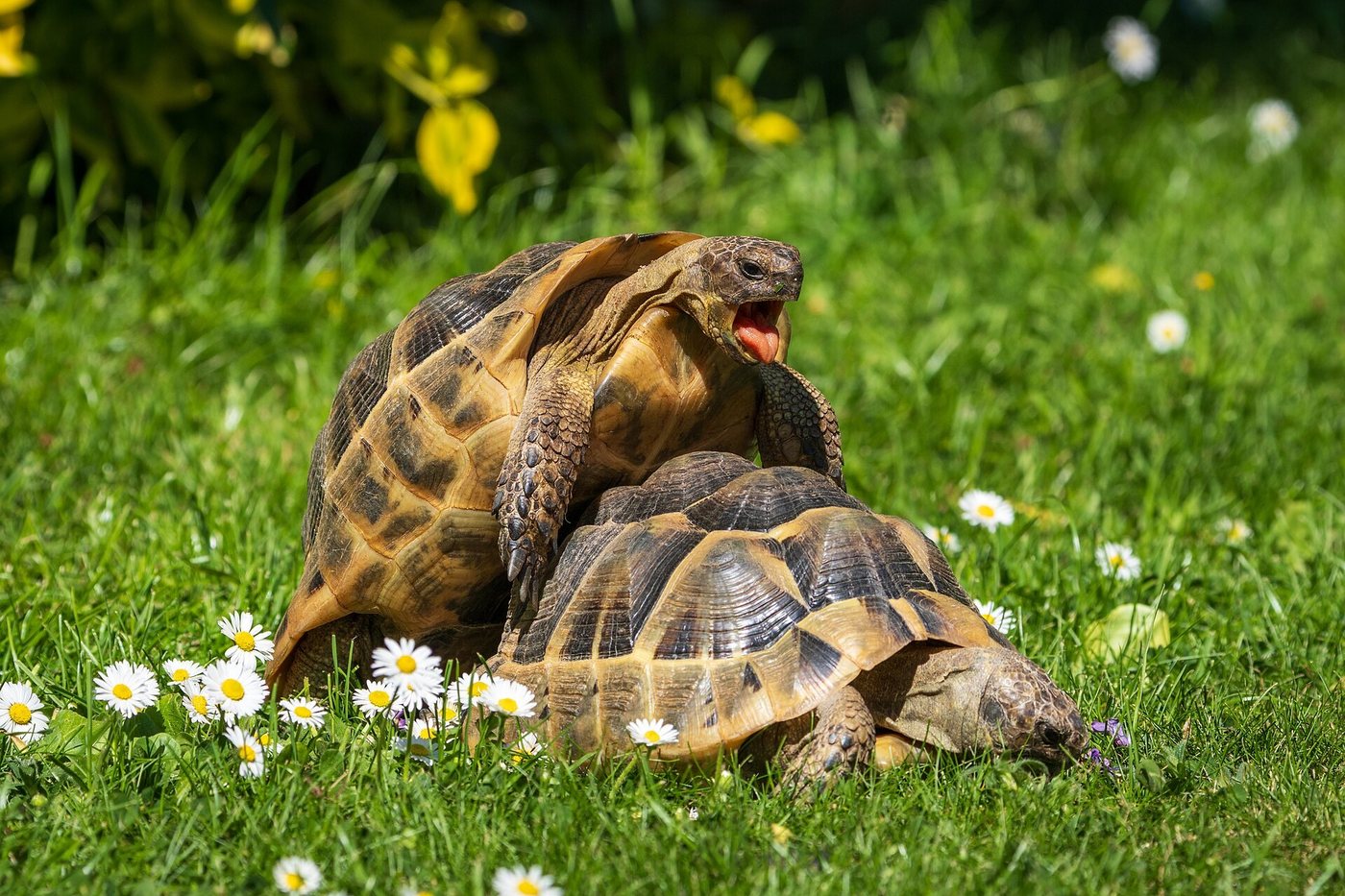
The Hermann's tortoise is the tortoise of Mediterranean gardens: a golden-brown, black-blotched little grazer that has lived alongside people in southern Europe for millennia and was the classic British garden pet of the last century. It is hardy, active, and full of personality, recognising its keeper and patrolling its territory with purpose. It is also a protected species under real pressure in the wild — which is why legitimate captive-bred Hermann's come with official paperwork, and why that paperwork matters.
Temperament & personality
Hermann's are busy, bold, and food-obsessed. They establish routines, learn where the weeds come from, and investigate everything at ground level. Males in breeding season can be relentless — butting and nipping at rivals and even at shoes — and are best kept apart from females or in carefully managed groups with far more space than the minimum. On a summer morning, a Hermann's marching its perimeter, grazing as it goes, is one of the most contented sights in reptile keeping.
Appearance
A domed carapace of warm yellow-to-olive ground colour with bold black blotches and bands — the eastern subspecies (T. h. boettgeri) is larger and duller, the western (T. h. hermanni) smaller, brighter, and more contrasted, with a distinctive black 'keyhole' marking toward the rear. The plastron shows two black bands. Identification points: a horny spur behind each thigh, and a tail tip ending in a small claw-like scale in males. Females are rounder and larger.
Care & daily life
Give a Hermann's the Mediterranean outdoors whenever the weather allows: a secure outdoor pen with sun, shade, a dry shelter, and grazing is the ideal, backed by an indoor tortoise table (4×2 ft minimum) for cold months. Basking spot around 95°F, ambient in the 75–85°F range, and a proper UVB source whenever indoors. Substrate should be soil-based and diggable. Feed wild-type food: weeds and leafy greens — dandelion, plantain, chicory, sow thistle — with calcium dusting and almost no fruit. A shallow water dish for drinking and soaking. Hibernation is natural for adults and widely practised by experienced keepers under controlled conditions, but it is a procedure, not a default — vet check first. Buy only captive-bred animals with their CITES/Article 10 paperwork in order, and keep that paperwork for life.
Health & lifespan
The Hermann's Tortoise is generally known for the following health watch-points:
- Respiratory infections, especially after cold, damp spells or poorly managed hibernation
- Shell pyramiding and metabolic bone disease from rich diets, low calcium, or missing UVB
- Internal parasites — get any new tortoise fecal-checked
- Post-hibernation anorexia and illness in animals that went into hibernation underweight or unwell
- Herpesvirus and other chelonian diseases — quarantine new animals away from existing tortoises
Living with a Hermann's Tortoise
Hermann's tortoises suit keepers in temperate climates who can offer an outdoor pen in summer and think in half-centuries: living 50–75 years, a Hermann's is routinely a two-generation pet. They are superb for gardeners (the tortoise regards the weed patch as catering) and for anyone who wants a genuinely interactive tortoise. They are not suited to small indoor tanks alone, to being mixed casually with other tortoise species, or to buyers who cannot obtain or keep the species' legal paperwork.
History
Hermann's tortoises have shared the Mediterranean with people since antiquity — their shells appear in Greek and Roman life, and the species is named for the French naturalist Johann Hermann. Through the 20th century they were imported into northern Europe in the millions as garden pets, a trade that devastated wild populations before CITES controls and EU protection (they are an Annex A species in Europe) restricted it. Wild populations remain under pressure from habitat loss, fire, and collection. Today's legitimate pets are captive-bred, sold with certificates — the paperwork is part of the species' conservation story.