Overview
The tokay is the gecko with a reputation, and it has earned every bit of it. One of the largest geckos in the world, powder-blue with orange spots, it calls its own name — 'to-KAY! to-KAY!' — from the shadows, and defends its tree hollow with an open-mouthed gape and a bite that draws blood and refuses to let go. Kept honestly, as a display animal in a big planted terrarium, a tokay is one of the most characterful reptiles in the hobby. Sold dishonestly, as a handleable pet, it is a 20-year grudge with teeth.
Temperament & personality
Tokays are solitary, territorial, and entirely unrepentant. Males call loudly at night in breeding season, and both sexes treat intrusions — including their keeper's hand — as challenges. A minority of captive-bred individuals tolerate brief, confident handling, but the species norm is defensive biting, and 'taming' attempts mostly stress the animal. Their appeal is elsewhere: boldness, beauty, voice, and the sense of keeping a genuine wild animal rather than a domesticated one. House them alone; even pairs can turn violent outside breeding introductions.
Appearance
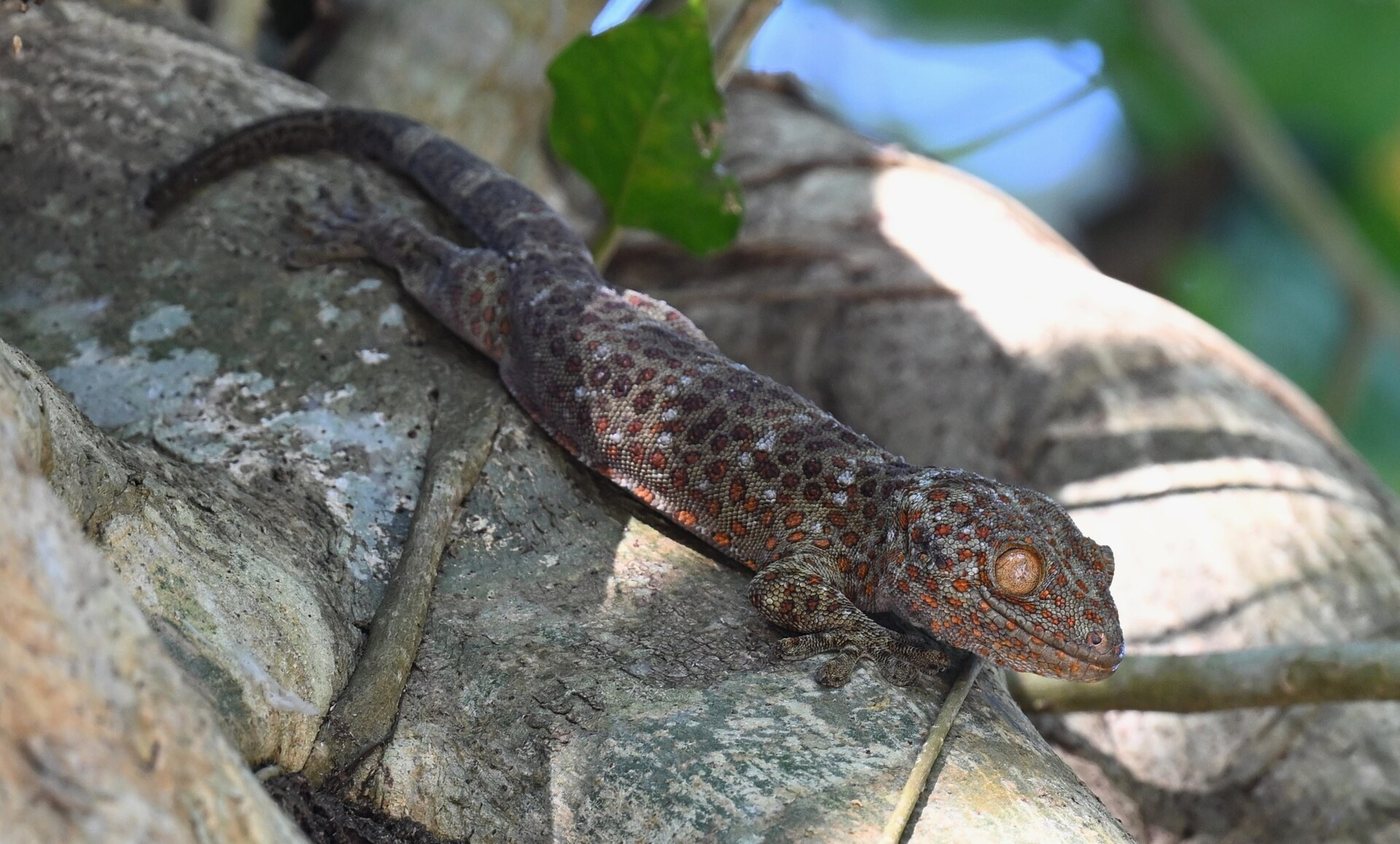
Unmistakable: a heavy-bodied, big-headed gecko in blue-grey skin studded with orange-red spots, with huge lidless golden eyes and vertical pupils. The mouth gapes black-lined and wide in threat display. Males are larger, more vividly coloured, and have visible pores and a broader head. Their toe pads are among the strongest in the gecko world — a tokay can walk across a ceiling carrying its considerable weight without effort, and can also climb straight out of an unsecured tank.
Care & daily life
Tokays need height, heat, and humidity: a vertical enclosure of at least 18×18×24 in (bigger is better), with a warm spot of 90–95°F, ambient temperatures in the low-to-mid 80s, and humidity of 60–80% maintained by misting and a planted or moisture-holding setup. Provide thick branches, cork tubes, and large foliage — they sleep wedged behind cork and leaves. Low-level UVB is beneficial. Feed substantial insects — adult roaches, large crickets, hornworms — every other day or so, dusted with calcium; big adults may take an occasional pinky mouse but do not need them. Spot-clean with long tongs, and plan enclosure maintenance around the fact that the occupant objects to you. Buy captive-bred: imported tokays are frequently parasitised and stressed.
Health & lifespan
The Tokay Gecko is generally known for the following health watch-points:
- Internal parasites — a large share of pet tokays are wild-caught or farmed imports; a fecal exam is essential
- Metabolic bone disease without UVB and calcium dusting
- Stuck shed and retained eye spectacle issues when humidity drops
- Mouth rot and bite wounds — including wounds between cage-mates, a reason to keep them singly
- Skin mites, especially on imported animals
Living with a Tokay Gecko
Tokays suit experienced reptile keepers who want a spectacular display animal and are genuinely content never to handle it — the tokay's terms are non-negotiable. Expect up to two decades, loud night-time calling from males, and maintenance done at tong's length. They are the wrong gecko for children, for beginners wanting a handleable pet (choose a leopard or crested gecko), and for light sleepers in small apartments. For the right keeper, nothing else in the hobby sounds, looks, or behaves quite like one.
History
Tokays are native across monsoon Asia, living in rainforest trees and — famously — in and around houses, where they are traditionally welcomed as insect-eaters and bringers of luck in parts of Southeast Asia; the name is onomatopoeic, from the male's call. Demand from the pet trade and, more destructively, from traditional medicine markets has put pressure on wild populations. Captive breeding is established but much of the trade still relies on wild collection, which is why sourcing matters for this species.