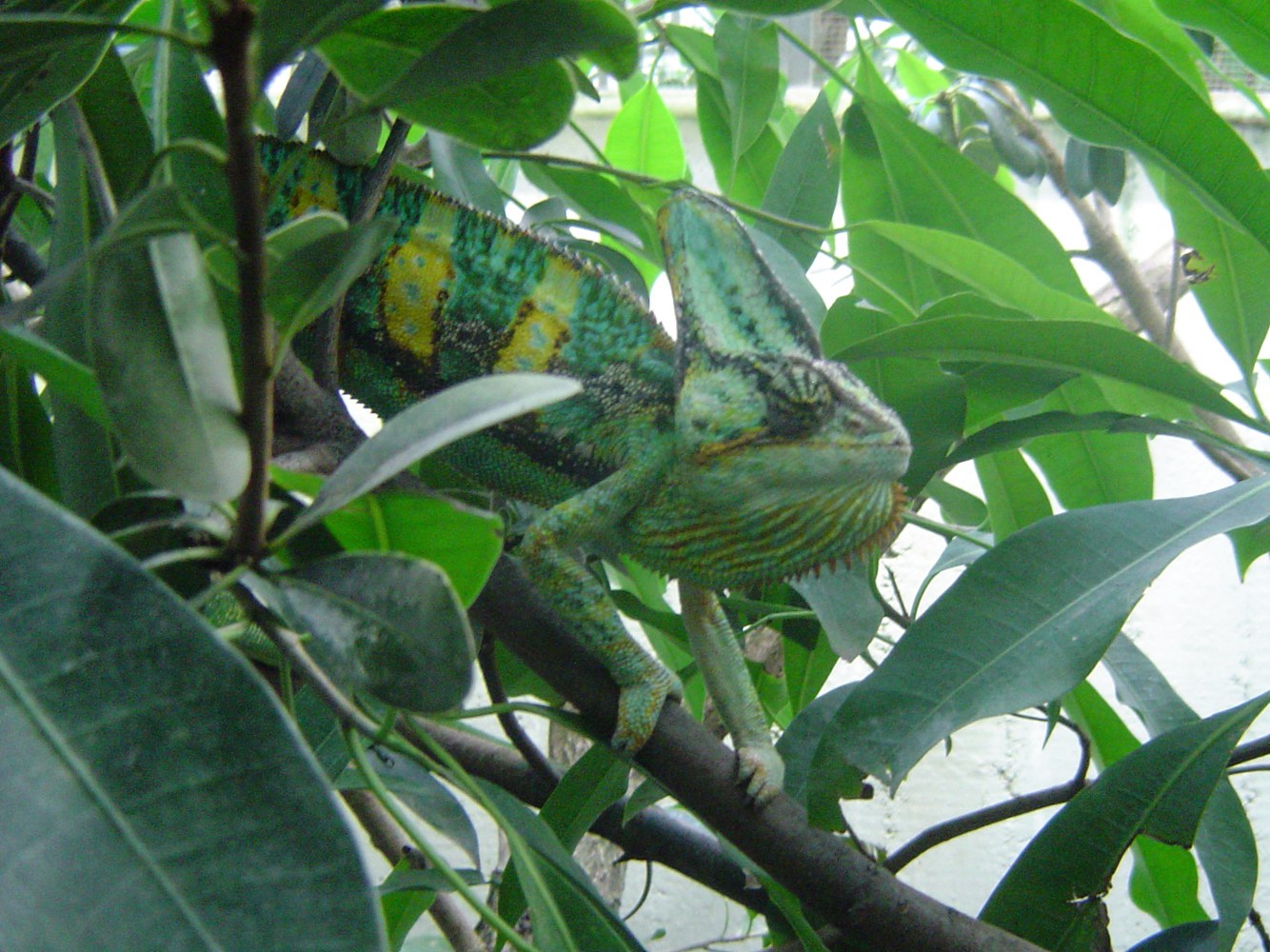
Overview
A veiled chameleon is less a pet than a small, slow weather system with opinions: it drinks fog, reads the room with two independently aimed turret eyes, fires a tongue longer than its body, and changes colour to file its complaints. It is also the most commonly sold chameleon — and one of the most commonly killed by beginner mistakes, because its beauty is beginner-priced while its care is not. This is the chameleon to graduate to, not to start with.
Temperament & personality
Solitary, territorial, and profoundly uninterested in human company — a veiled chameleon's social contract is observation from a respectful distance. Males patrol their cage crowns and flare at rivals (including their own reflection); females are shyer still. Handling is experienced as a predator event, and a 'tame' chameleon is usually a stressed one performing stillness. Accept those terms and the reward is real: few animals are as absorbing to simply watch go about their slow, deliberate business.
Appearance
A chameleon built like a living sculpture: a tall, helmet-like casque on the head (largest in males), a laterally flattened body, mitten-shaped fused toes (zygodactyl feet) for gripping twigs, independently swivelling turret eyes, and a prehensile tail that curls into a neat spiral at rest. Males wear green with pale vertical banding and speckles that intensify with mood; females are a more uniform green with yellow and blue spotting, turning dark with bright yellow spots when gravid. Colour change is real but subtle — a mood and temperature dial, not a magic invisibility cloak.
Care & daily life
Veiled chameleons are kept, not just housed. Start with a tall screen enclosure (airflow is essential; glass tanks cause problems) with live or safe artificial plants, branches at many heights and thicknesses, and a basking spot of 85–95°F over a gradient falling to the low 70s. Lighting needs a proper UVB tube plus the basking lamp on timers. Water is the daily art: chameleons drink droplets, not bowls, so the enclosure must be misted several times a day and/or fitted with a dripper — many keepers run a fogger at night to push humidity high while the animal sleeps, letting it fall to 40–50% by day. Feed gut-loaded crickets and roaches dusted with calcium at every feeding (females and juveniles especially), and supervise supplementation carefully: too much vitamin A/D3 is as dangerous as too little.
Health & lifespan
The Veiled Chameleon is generally known for the following health watch-points:
- Metabolic bone disease — chameleons are exquisitely sensitive to calcium/UVB imbalance; rubbery jaws and bowed limbs are late signs
- Egg binding and follicular stasis in females — a leading killer; even unmated females produce eggs
- Respiratory infections from stagnant, humid air — ventilation matters as much as humidity
- Gout and edema (swollen neck/throat) linked to over-supplementation and kidney strain
- Eye infections and retained shed, plus chronic low-grade dehydration
Living with a Veiled Chameleon
Veiled chameleons suit experienced, observant keepers who want a living artwork and a husbandry project, and who accept the terms: you watch; you do not cuddle. Daily misting (or automated systems), insect keeping, and precise supplementation are the relationship. They are a poor choice for classrooms, children wanting a handleable pet, or anyone whose schedule means the mister runs dry for days — and females' shorter, egg-burdened lives deserve honest thought before choosing a sex.
History
Veiled chameleons come from the high plateaus of Yemen and southwestern Saudi Arabia, where they live in acacia trees above the clouds' daily mist line — the origin of their unusual need for dry days and saturated nights. Described scientifically in 1851, they became common in the pet trade only in the 1990s, when captive breeding (they are prolific) made them affordable. That affordability, combined with their alien beauty, put a genuinely demanding species into beginner hands at scale — the central tension of chameleon keeping ever since.