Overview
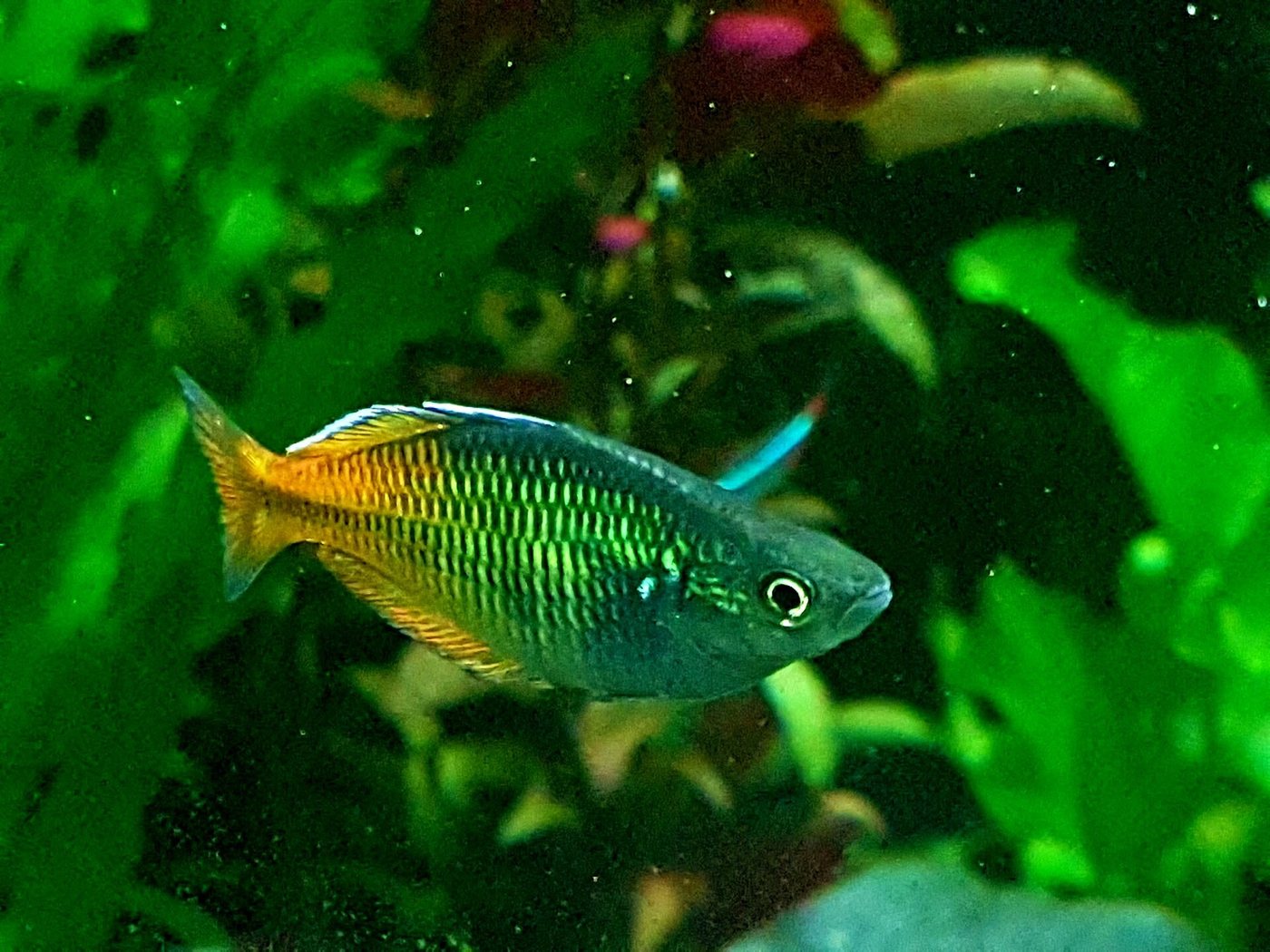
The Boeseman's is the rainbowfish family's ambassador and its best practical joke. The adults in photographs — front half slate blue, back half molten orange, split down the middle as if dipped — are genuinely what a mature dominant male looks like. The fish in the dealer's tank, grey-olive and forgettable, is the same animal at ten percent of its story. Between the two lie a year or two of feeding, space, and social competition, which is why Boeseman's keepers sound like wine people: the investment is patience, and the payoff is a dawn display of sparring males that few four-inch fish can match.
Temperament & personality
Rainbowfish are morning fish: the day's social summit happens in the first hour of light, when males flare, darken, and chase in rituals that set the hierarchy and fire the colour. The rest of the day they cruise mid-water in a loose, active school — peaceful with everything their size, too quick and confident to be bullied, too mild to bully. They are surface-and-midwater show-offs without malice, the rare display fish that can headline a community without rearranging it.
Appearance
Two fish, one body: the male Boeseman's front half is steely blue-grey and the rear half — from mid-body through the tail — is sunset orange-yellow, split with a precision that looks airbrushed. The body is deep and oval, the fins orange-edged, and a prime male in morning light is among the most startling sights in freshwater. Females and juveniles are a study in disappointment by contrast: olive-yellow, muted, with hints of the pattern — which is why shop tanks of grey-green youngsters sit unsold beside this fish's reputation. The colour arrives with age, diet, and dominance, and it is worth the wait.
Care & daily life
Give a group of six or more (more males than females, or balanced — males colour hardest in competition) a long 55-gallon tank ideally; 30 gallons houses a smaller group acceptably, but length is what rainbowfish spend. Water at 76–82°F, medium-hard and alkaline, well oxygenated with real flow. Feed an omnivore diet with colour-bearing ingredients: quality flake and small pellets, daphnia, mosquito larvae, and vegetable matter — carotenoid-rich foods visibly feed the orange. Rainbows are jumpers; lid the tank. The standing warning of the species: shop fish are juveniles and look like nothing. Budget two years, feed them like athletes, and the poster fish arrives on schedule.
Health & lifespan
The Boeseman's Rainbowfish is generally known for the following health watch-points:
- Columnaris ('mouth fungus') in stressed or poorly kept rainbowfish — the group's signature weakness
- Mycobacteriosis in chronic, older groups
- Ich and velvet after chilling — rainbows dislike cold snaps
- Inbreeding dullness and deformity in closed farmed lines — buy from varied stocks where possible
- Obesity on rich diets without swimming room — length of tank is preventive medicine
Living with a Boeseman's Rainbowfish
Boeseman's suit active community tanks of 30 gallons and up (55 for the full effect), keepers drawn to a fish that matures into its beauty, and dawn watchers — the males' sparring display is a morning show. They are wasted on nano tanks, cold or soft-blackwater setups, and anyone unwilling to wait out the grey juvenile phase. As a long-lived schooler they reward exactly the keeper the shop tank discourages.
History
Boeseman's rainbowfish comes from a single lake system — Lake Ayamaru and its tributaries on the Bird's Head Peninsula of New Guinea — where it was collected for science in the 1950s and named for Dutch ichthyologist Marinus Boeseman. Exported for the hobby from the 1980s, it became the rainbowfish that introduced the whole family to mainstream aquarists. Wild populations have been pressured by collection and introduced species, and the species is conservation-listed; virtually all shop fish are now captive-bred, principally in Asia and Europe.