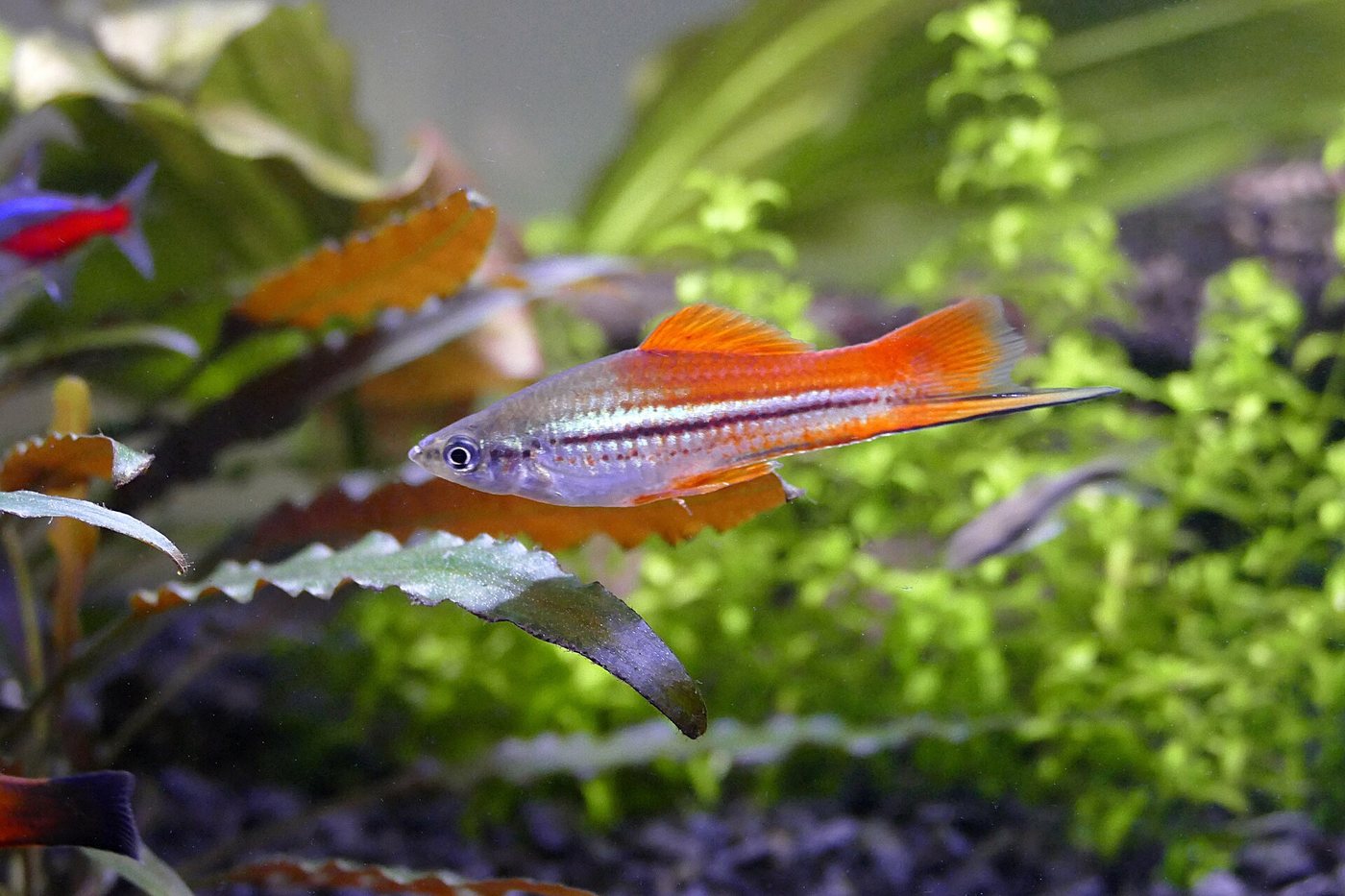
Overview
The swordtail is a livebearer with presence: four or more inches of olive-gold fish, the adult male trailing a long pointed extension of his tail fin like a fencer's foil. It is active, bold at feeding, and just assertive enough within its own species to need thought about numbers and space. Like the platy, it breeds without any encouragement whatsoever; unlike the platy, a swordtail tank has a social drama running in it — dominance, duelling males, the occasional female who decides to run the tank — which is a good part of the fun.
Temperament & personality
Swordtails are confident, food-forward fish that use the whole tank, with males displaying, chasing, and fencing harmlessly among themselves. A single male in a roomy tank is a monarch; two males in a small one is a feud — either keep one male or a genuinely spread-out group with several females per male and broken sight lines. Females are steadier but the largest often dominates everyone. Toward other species they are well-behaved, though their size and appetite mean tiny tankmates stay wisely nervous.
Appearance
Wild swordtails are olive-green with a reddish lateral line and a modest sword; the aquarium strains are showier — solid reds, velvet oranges, tuxedo black-and-red, koi patterns, pineapple, and high-fin and lyretail forms. The male's sword, an extension of the lower tail fin only males carry, can nearly double the fin's length; females are larger, deeper, and swordless, their tails rounded. A late-developing curiosity of the species: some old females develop a sword and male colouring — functionally still female in most cases, and a famous puzzle for new keepers.
Care & daily life
Length matters more than volume: a 20-gallon long (or longer) gives swordtails the swimming room and the males the territory geometry they need, at 72–82°F in hard, alkaline water. Fit a lid — swordtails are committed jumpers. Filtration can be moderate; they like a little flow. Feed a varied omnivore diet with real vegetable content, small meals twice a day. Then the standard livebearer decision, with interest: swordtail fry output is generous and the fry are relatively large and hardy, so a mixed-sex group in a planted tank will genuinely populate it. Keep males-only for peace, or plan homes for the young.
Health & lifespan
The Swordtail is generally known for the following health watch-points:
- Ich, fin rot, and columnaris under stress or chilling — the standard livebearer complaints
- Skin flukes and other parasites, commonly introduced with new stock
- Inbreeding decline in heavily line-bred show strains
- Hybrid tumour susceptibility (melanoma) in some platy–swordtail crosses — a known quirk of the genus
- Injury from male duelling in cramped tanks — space and planting are the medicine
Living with a Swordtail
Swordtails suit keepers with a 20-gallon-plus long tank who want an active, unfussy centrepiece shoal, and pair well with platies, larger tetras, corydoras, and peaceful medium fish. They are too boisterous and, eventually, too mouthy for dedicated nano tanks with cherry shrimp colonies and tiny fry of other species. The honest commitments are a lid, length, and — as ever with livebearers — a fry plan.
History
Swordtails hail from the rivers of Mexico south to Honduras, where the green swordtail (Xiphophorus hellerii) inhabits everything from mountain streams to lowland ditches. In the hobby since the early 1900s, it was intensively crossed with platies to build the modern colour strains — crosses so fertile and genetically tractable that Xiphophorus became a laboratory model for cancer genetics, studied at dedicated stock centres for a century. The name game is simple: the sword advertises a healthy, mature male, and females in the wild choose for it — the hobby just inherited the fashion.