Overview
The zebra danio is the aquarium's indestructible metronome: a fingerling of striped lightning that treats the tank's surface as a racetrack and its schoolmates as fellow competitors. Its toughness is legendary — the fish that survives the beginner's first tank, the uncycled emergency, the forgotten heater — though 'survives' should shame the conditions rather than praise them, because in a long, cool, flowing tank zebras are not merely alive but glorious: courting at dawn, scattering eggs, streaking the waterline in a living braid. Small, cheap, and inexhaustible, they are the hobby's benchmark schooling fish.
Temperament & personality
Zebras are the most relentlessly cheerful fish in the trade: dawn finds them already chasing, sparring, and displaying, and their social life is conducted entirely through motion. There is a pecking order, maintained by charges and feints rather than contact. Toward other species they are benign but busy — a feature, or a bug, depending on the tankmate: shy fish find the perpetual carnival exhausting. School of ten, and the behaviour rounds out into something genuinely beautiful — a braided, flashing ribbon of fish working the whole tank.
Appearance
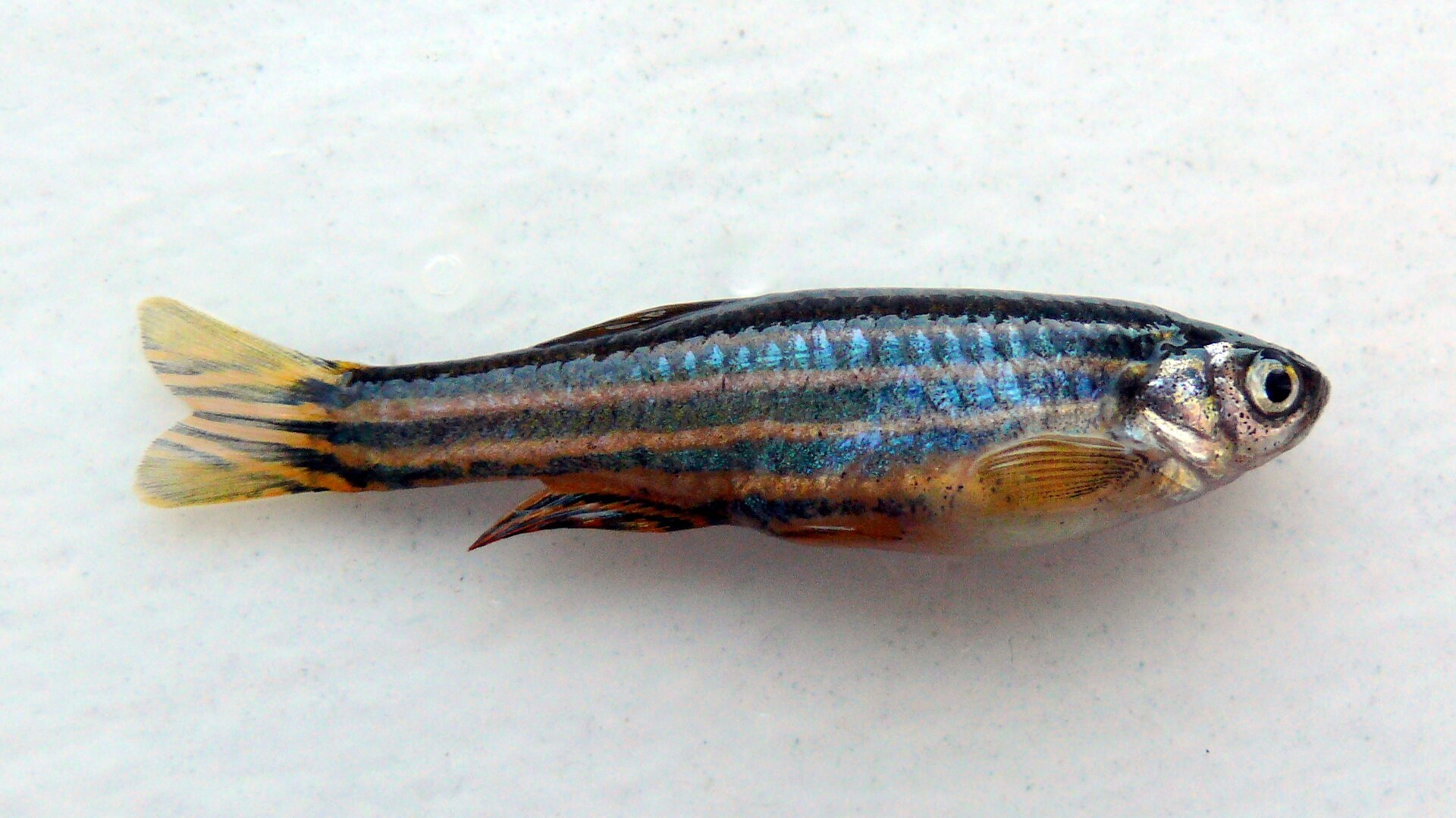
A little silver-gold torpedo wearing five horizontal navy stripes from nose to tail — the stripes continue into the tail and anal fins, which is how you know it's a real zebra and not a lesser-striped danio. Females are plumper, especially when full of eggs, and slightly less vivid; longfin, golden, and albino variants exist, and the famous GloFish form carries fluorescent jellyfish and coral genes that make it glow green, orange, or pink under blue light. Wild fish from some populations lean toward spots where stripes break up with age.
Care & daily life
Prioritise length: a 20-gallon long is the honest minimum for a group (10 gallons is survivable but confines their sprinting), with a secure lid because danios jump with intent. Keep the group at six minimum, ten happier. Water at 64–75°F — notably cooler than most tropicals — with decent flow; a river-style current entertains them. Feed small insect-based foods daily (they burn fuel like engines): micro-pellets, crushed flake, daphnia, mosquito larvae, baby brine shrimp. Tankmates should tolerate cool moving water and not be slow or flowing-finned; danios investigate everything and can pester the placid. A planted tank with open race-track lanes at the front is zebra danio paradise.
Health & lifespan
The Zebra Danio is generally known for the following health watch-points:
- Mycobacteriosis ('fish TB') — wasting and ulcers in chronic cases; the danio's most serious endemic risk, also a lab-colony scourge
- Inbreeding decline and spinal deformities in mass-bred stock
- Ich after cold shocks or arrivals into poor water
- Velvet and skin flukes, usually imported with new fish
- Age-related wasting in old fish despite good water — a short-lived species' normal endgame
Living with a Zebra Danio
Zebras suit beginners with length of tank, cool-water communities (white cloud mountain minnows, gold barbs, hillstream-type setups), and anyone who wants constant motion at the top of the water column. They are wrong for slow, shy, long-finned companions (a nipped betta is the classic mismatch), cramped cubes that give them no track, and warm-water discus-style setups — 75°F is their ceiling, not their floor.
History
Zebra danios come from slow streams, rice paddies, and seasonally flooded pools across northern India and Bangladesh. They became aquarium staples in the early twentieth century — but their second career eclipses the first: the zebra danio is one of biology's great model organisms, a vertebrate whose transparent embryos develop outside the mother and whose genome is fully sequenced, making it a laboratory mainstay for genetics and developmental research. The pet-trade GloFish of the 2000s made it famous a third time, as the first genetically fluorescent pet.